Aaaand I’m back. Just 10 days ago, I typed up the hopeful, giddy post, Onward to Worldcon. In it, I wondered just what kind of cool adventures and experiences I would have had over the following week.
Much has changed.
Short version: many adventures were had. My overall impression of my first-ever Worldcon was positive, and I’ll definitely attend the next one in California. Many fun new friends.
Long version: wild week, eh. I tried to fill every waking moment with new experiences and friends and panels and parties, and I had very very many waking moments, since I slept only about 4-5 hours per night.
Worldcon felt to me like an intricate clock with ten thousand moving pieces. Some of the pieces had redundancies, so if something failed (and I’m sure many things did), we the attendees never found out. It was a monumental event of staggering complexity, and the fact that it went as well as it did is a testament to the combined efforts of all the volunteers. Sincere and heartfelt kudos to you all, my friends.
There’s a lot to process here, and I’m sure random bits and pieces will fall into place weeks and months later. For now, though, here’s a list of the good, the bad, and the fugly.
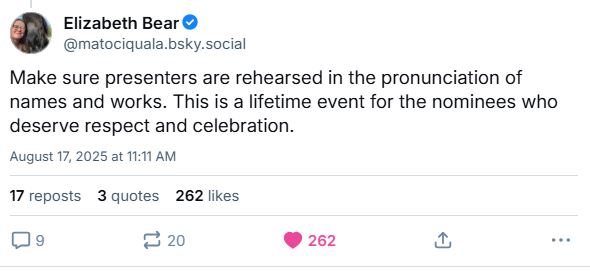
To start with, the fugly. The essay I posted yesterday, When People Giggle at Your Name, or the 2025 Hugo Awards Incident, has been improbably successful. Over 8,000 blog views within 24 hours, over 1,400 likes and 800 reskeets (yes, we call them “reskeets” – no, we will not change), and so many excellent conversations. That’s more than I could ever hope for. Anyhow, not much else for me to say on that front.
The second fugly aspect was the registration line… My initial plan had been to fly in the night before (Quebec City -> Chicago -> Seattle), crash at my brother’s place, get a 7am bus to the convention center, get my pass, and make it to one of the 9am-ish panels.
Reality interfered. The flight to Chicago got delayed to the point where I had to spend the night at the airport, and didn’t get to Seattle till 9:30am. I raced from there directly to the convention center, big backpack in tow. (Experienced traveler tip: always carry deodorant, toothpaste, and a toothbrush! That cost me five minutes, but it made me much more pleasant to be around, eh.)
I arrived at the convention center at 10:30am. And then… Then I spent almost two hours waiting in the registration line. One of my many, many privileges (of which I’m constantly cognizant) is that I’m physically fit and in good health. Even so, that line almost defeated me. I can’t even begin to imagine what it must have felt like to those who had mobility issues or couldn’t spend two hours surrounded by the loud crowd on all sides.
The convention staff claimed there were some connectivity issues. (They apparently lasted the entire first day, judging by the Discord chatter from those who tried to watch panels remotely.) If there was a backup in place, it must have failed. I was sleep-deprived and borderline delirious, but I swear I heard them ask the folks in line if anyone could join them and help with processing the registration passes.
As we got closer to noon, they made another announcement, telling the panelists with the upcoming panels to step aside for the express line so they wouldn’t actually miss their panels. It was not good… The wait was made worse because my neighbour in line was a) an old-timey Worldcon visitor, with 20+ years of convention memories, and b) incredibly cynical: they kept saying how none of the opening/closing events mattered, etc, etc. Later, during the second hour, my neighbour moved on to describe their daily routine, their preferred type of digital tablet, and more. Unbidden. I nodded and tried to filter it all out and kept promising myself that the day could yet be salvaged.
Finally, at 12:15pm, I finally got my pass with the neat little “my first Worldcon” ribbon and raced upstairs, to find the third panel on my daily schedule.
From what I understand, it’s not always like that. What I don’t understand is what specific cascade of issues caused all that. Later in the day, folks who arrived at the convention center in the afternoon claimed it still took them 90 or so minutes to get processed.
This… kerfuffle, let’s call it that, made me wonder if maybe, just maybe, I ought to throw my hat into the panelist pool for the 2026 convention. I know a lot about several topics, and will gladly contribute my knowledge if they’ll have me. I would do just about anything to minimize any further chance of being stuck in the Line From Hell. (Yes, folks, it was that bad.)
So that was the fugly: the registration at the start and the name-mangling giggling mess toward the end. I’ll intersperse the good and the bad.
Good: the variety of panels was mind-blowing! Hundreds of them, with at least 10 to pick from for any one-hour slot. (Some went longer than an hour.) Some panels were so full that folks sat on the floor (the ones with GRRM and Martha Wells, for example), while others were oddly sparse, like the panel on the future of energy. (It had an excellent mix of experts in the field. One of them gave me their personal email address since they don’t have a blog, huzzah!)
Bad: folks, I get that it was all volunteer-run, but some of the moderators… There were two particularly bad examples. At one panel, the moderator never even showed up. The panelists were three women, who were all published authors, and a 95-year-old man who used to be a UW professor. (If I recall correctly, he may have published something at one point.) The panelists decided to self-moderate. The old man turned his introduction into a bona fide speech. Weird, but okay. When the panelists decided to discuss the panel’s topic (I’m being vague here: no topic, no names), the old man interrupted one of the women and launched into an honest-to-God lecture on the topic, as if we were a bunch of college freshmen. He went on and on and on. I finally stood up and walked out. Quite a few people followed me. I felt so incredibly sorry for those panelists…
The other weirdly moderated panel actually had a moderator. The moderator was a woman, as were all the panelists. (One of them is among my favourite podcasters!) Problem was, the moderator wasn’t sure what her job entailed, and an impatient panelist had to explain it to her. Over the hour that followed, the moderator launched into looooong monologues about her personal involvement with the panel’s subject. She talked on and on, longer than any two (out of four) panelists put together. The audience grew restless. The poor panelists couldn’t hide the impatience and frustration from their faces. Finally, the impatient panelist interrupted the moderator when the filibuster showed no sign of slowing down. Some discussion among the panelists took place. The offended moderator buried her hands under the table, texting or browsing or doing who knows what else on her phone.
Five minutes before the panel was scheduled to end, the moderator finally looked up, realized she missed something, and announced that it was time for some Q&A. The panel went wayyy past the one-hour mark so, once again, I felt like a jerk by getting up and walking away, to get a good seat at the next panel before it filled up. Ho hum.
Good: the panel on navigating AI for writers and editors was excellent, in large part due to Jason Sanford, who made it very very clear that, as a moderator, he would not suffer fools gladly – or at all. He kept the ideologically polarized crowd in check, especially after one of them jeered something in support of the pro-AI panelist. Sanford sounded downright intimidating from time to time, but he made sure the panel stayed on track, he didn’t monologue, and he gave each of the four panelists time to speak.
Neil Clarke, of the Clarkesworld fame, spent most of the hour literally facepalming as a blatantly pro-AI “author” opposite him used every pro-AI excuse in the book, (The other two panelists were a pro-consent, anti-AI professor, and another professor who kept saying how neat it would be to have an AI cowriter…) Neil has been an anti-AI champion with his magazine for years, and he made his point quite clear during that panel. Later, at the awards ceremony, he gave a brief but passionate anti-AI speech when he accepted his Hugo for the best short-form editor. You rock, Neil! Keep up the good fight, eh.
Bad: food and coffee options inside the convention center. It was very very strange to see that the sole coffee stand (and in Seattle, no less!) packed up and left for the day by 5:40pm. With thousands of caffeine addicts milling around, you’d think that the baristas’ overtime wage would’ve paid for itself within five minutes. (Or hey, maybe their boss could come by and take over…) But nope. The overpriced food vendors on the exhibit floor also folded up by 6pm. I more or less had to beg them for the privilege of buying a small bag of chips and a coke for the low, low price of $8. Oof. Oof, I say. (And no, there were no vending machines.)
Good: the 7am coffee meet-ups were excellent. Part of the Fringe program, they were partly a tour of Pike Place, partly a way to make new friends, which we all did. I’ve made it out to just two of those early meet-ups, I think, and the second one ballooned into an awesome one-on-one conversation of humanity and theology as it pertains to sci-fi and fantasy. (“Those aren’t gods – you just recreated superheroes!” Heh. You rock, C.W.) Granted, there wasn’t much to do at the actual convention center before 10am (aside from a few very early panels) because the exhibit floor stayed closed till 10pm, but nonetheless – those coffee meetups were wholesome and fun and edumacational. (If you ever travel to Seattle, touring Pike Place around 7am is a unique experience: it’s empty and devoid of crowds; quite different from the rush hour.)
Bad: you know, I’m actually out of bad stuff – it was overwhelmingly good! The only borderline weird thing was the nature of the big masquerade event. At first, I assumed it was going to be a masked ball. One of the old-timers assured me that was not the case: all were welcome, mask or no mask. After that reassurance, I assumed it was going to be a masked ball, but with mask-less folks welcome to attend and mingle. Welllll, it was actually more of a fashion show. Folks sat in the huge auditorium, while up on stage, cosplayers of all kinds took turns to display their amazing costumes. (Giant squid person – you were a genius!) That was a very different pace and vibe than I’d expected, so I hung around for just 10 minutes before bouncing out.
Good: authors! It was so, so great to finally meet my favourite authors in person. I’d met Matt Dinniman (he of the Dungeon Crawler Carl fame) a few times before, but I kept running into him at the convention, and the two panels with him that I attended were brilliant. A genuinely nice guy on top of being a great author! Mary Robinette Kowal is now at the very top of the list of authors I’ll read once I get through the books on my short-term list. (Geek problems, am I right?) Her live taping of the “Writing Excuses” podcast (with Erin Roberts and Howard Tayler) taught me more about writing than some of the 200-page writing manuals I’d encountered in my journey. In a building full of brainiacs, she stood out by a long shot.
Meeting John Scalzi and GRR Martin was also fun. I’ve been reading Scalzi’s blog for about 20 years now, and it was great to finally put the voice to the persona. (His pink unicorn “Alpha Male” T-shirt was excellent trolling.) Martin showed up 12 minutes late to his own panel, did quite a bit of monologuing, and had to be gently (but firmly) stopped by Scalzi when his monologues got too long. Interesting guy. I was not at the event (autograph signing?) when one of Martin’s extra-toxic fans asked if he could please hurry up and give his series to Brandon Sanderson (who was also present) before dying of old age. Ye gods… That might have been the ugliest fan interaction Worldcon has experienced in years. It felt as if one of the extra-toxic subreddits breached containment.
Good: the Freebie Lounge! That was such an interesting part of the convention… It was located in the corner of the big exhibit hall on the second floor. There were books, books, and more books. Some titles had been brought by authors seeking to boost their recognition: dozens of books, shrink-wrapped and waiting to be picked up. Some authors set up a little autograph table for their freebie books. (Great strategy!) There were a lot of old-timey sci-fi magazines from the 60s and 70s: I snagged a couple, and will devour them at leisure. (Retro sci-fi is quite different from the stuff today, for better and for worse.) There were also the latest issues of today’s top magazines: Asimov’s, Clarkesworld, and Analog.
The local SFF fans helped out by donating books from their own collections, which was unexpectedly wholesome! That’s how I got my hands on four Terry Pratchett paperbacks. (I’m on a long-term quest to acquire every Terry Pratchett novel, but only from thrift stores and/or freebie locations.)
I had to be very selective (limited luggage space, limited shelf space) but even so, I ended up with 11 books, including lots of amazing fanzines! The most unexpected find was the hardcover copy of Seventy Maxims of Maximally Effective Mercenaries by Howard Tayler, creator of the Schlock Mercenary comic. The book is in the format of Art of War (one rule, many commentaries), except that it’s annotated by military grunts and mercenaries from the distant future. It’s beyond funny. Tayler was kind enough to sign it for me when I bumped into him at a panel later that day. (What a guy!)
Good: parties! All in all, I partied for five nights straight – the sixth night was a fun barbecue after a day of hiking near Mt Rainier. (Probably the best yet least attended Fringe event. Only nine sign-ups out of 5,000+ attendees!) I’m an introvert who is very very good at storing social energy, much like a sloth has a hidden reservoir of energy reserves. The convention had a dedicated dry-erase board where different party organizers could promote their events.
A few were somewhere in the city, but most were at the nearby hotel, three or four at a time. The hotel’s elevators couldn’t quite handle all the traffic, and required a key card to use them after 10pm. At one point, our gregarious gaggle of geeks got tired of waiting and just started going up and down the stairs, following the noise on each floor till we found an unlisted (but not unwelcoming!) party. Much fun was had by all, especially at the famous annual Dead Dog Party (disregard the odd name) that was bigger and more attended than all the other parties combined. Huzzah!
Good: friendos! Sooo many new friendos. Many emails were exchanged. Lots of social media connections were forged. At least one epic conversation will continue.
Not bad, but funny: as someone only tangentially aware of Worldcon (this was my first), I’d always heard about the so-called Bar Con, aka the after-panel meetup at the nearest bar, where all the writers would trade lore and tips and gossip, being all cool and writer-y. For some reason, in my mind’s eye I’d always thought it would be a fancy, private-club sort of affair, with posh velvet chairs, relaxed lounge music, and fairly quiet, witty conversations…
Reader, I was wrong. I was so wrong that it’s actually pretty damn funny. (I guess it’s a good thing I didn’t pack a full-on suit in my Osprey backpack!) The bar at the nearby Sheraton hotel had writers, yes, and fans of said writers, and many many other people. Hundreds of them, actually. It was louder than some of the concerts I’ve attended in the past, and that just added to the hilarious mismatch of my expectations and the actual reality.
It was a bit odd when the hotel’s bar stopped serving drinks at the stroke of midnight. That was on Saturday night, no less, right after the awards ceremony, which mercifully ended around 10:40pm. Later on, I heard that that the city ordinance is to stop serving drinks at 2am. Soooo, much like with the coffeeshop, when you make a deliberate choice to stop serving drinks to a giant crowd on a Saturday night… Weird business choice, brah. (I know, I know, Worldcon had no part in it. Just listing my personal subjective experiences.) Nonetheless, I made a couple of new friends in that Bar Con crowd, so all was well.
Good: SFWA events! I wrote recently that I managed to join the SFWA after making juuuust enough money to exceed their associate member threshold. Their members-only breakfast on Friday, followed by a networking reception just before the awards on Saturday, was fun. I did end up accidentally talking to at least one AI apologist (eww. Eww, ewww, ewww.) but the vast majority of them were cool cats. There was an issue with SFWA forums during the convention, so I joined their Discord server (not my favourite platform: bad archival functionality), and made even more friendos that way!
Good: film festival! My short film Please Don’t Send Help screened on Thursday, to the audience of about 80 people. There were approving-sounding face noises. There were no rotten eggs or tomatoes or booing or riots. There was a very small but cozy Q&A at the end (thanks, Shawn!) and at least one person who recognized me and stopped by to chat a few days later. It’s always wild to see something I created on a big screen. What an excellent treat.
Neither good nor bad: my writing streak took quite a hit, and that’s entirely on me. I tried (mostly failed, but tried) to write at least a little bit on my phone’s Notes app every day, and managed to type up exactly 2,183 words. Better than nothing, but not a whole lot, considering I was away for eight whole days. Ah well, it was still progress. Today was the first day when I actually sat down and typed typed typed. The end result: 1,644 new words for my first draft. Not too shabby.
Super-good: sooo much inspiration! I jotted down ideas for at least three new short stories, as well as a sci-fi novel that would actually utilize my degree in political science. (Seriously, it’ll pretty much write itself.) Just gotta finish the current WIP, which has just reached the 55% or so mark… It’s good to have more ideas than you know what to do with! I also took lots of notes on book recommendations (as well as the occasional movie) from all the panelists. My reading list will never ever run dry, and that is beautiful.
And so… Fun event. Not perfect, not terrible. Will come again. Lots of fun free books (the best kind!) for my reading pile. I haven’t checked yet, but I believe the organizers are uploading the panels that got filmed (not all got filmed) and will keep the files available till the end of the year. So much to stream!
A year from now, I’ll be the grizzled second-year Worldcon attendee – to quote a joke, “This isn’t my first rodeo!” I say at my second rodeo.
I’ll see you all there, I hope.

 Grigory Lukin.com