Tag Archive: sci-fi


It’s August 16, 2025, Worldcon, Seattle, and the main presenter of the annual Hugo awards butchers almost every foreign name on the list. When trying to pronounce an unusual African name, the presenter giggles.


It’s 1934, and Frank Lloyd Wright designs his masterpiece, Fallingwater. The beautiful house sits over a waterfall. To an outside observer, it’s a marvel of architecture, a fusion of engineering and nature. To the people who actually live there, it’s an endless nightmare of leaking roofs and cracked concrete. Fallingwater’s owner nicknames it “Rising Mildew.”


The 2025 Worldcon had hundreds of panels and thousands of attendees. It had fantastic freebies and fanfic fans and fun filking. It had authors and poets and filmmakers and podcasters. It had five full days of genre celebrations, of coming together as one.

It also failed at its most basic, fundamental purpose.

The cornerstone of this annual gathering is the Hugo awards ceremony. During the days leading up to the big event, the convention attendees engage in quiet discussions about the nominees. They wish their favourite authors the best of luck. They recommend the finalist books and art to all their friends.

And then… Then the esteemed Hugo awards host (as well as the secondary host) mispronounces non-English names, over and over. (Even Denis Villeneuve wasn’t spared.) They skip one of the nominees altogether, making the audience shout in unison, after which there is some awkward fumbling. (“Did we miss one? Oh no! Why aren’t they on the list? … Clearly they have to win because they were on the second page.”)

(That nominee did not win.)

The skipped nominee was Kamilah Cole, a Jamaican-born woman, whose only fault, it seems, was having her name on the second side of a page. (Typing on both sides of the page is a brand new technological development. Very few people have heard of it. We cannot expect mere Hugo awards hosts to keep up with such groundbreaking inventions.)

A house is supposed to keep you safe and dry, even when – or perhaps especially when – it doubles as a work of art. If it can’t do that bare minimum, it becomes worse than useless. It turns into a liability.

Likewise, an annual awards ceremony that fumbles that most basic of all tasks – pronouncing the finalists’ names – fails at its most basic purpose.


It’s May 2004, rural Nevada, high school graduation. The kind of school where many students get pregnant before they get their diploma. The kind of school where the biggest scandal of the year is the video of two boys kissing at a house party. The kind of school where the History teacher stops in the middle of a joke, chuckles, and says, “I’ll finish it later” when he realizes one of the school’s three Black students is sitting in the back of the class. The kind of school where all the students get lined up against the wall every few weeks, while a gigantic German Shepherd sniffs each crotch, presumably seeking drugs, and its handler, a gun-wielding cop, smirks.

It’s that kind of school. In a small desert town with one big street, one Walmart, and more casinos than libraries.

And as the graduation ceremony approaches, I worry that the announcer will butcher my name, just like most of my American classmates have during my sole year with them. The big day comes, and I’m beyond amazed when the announcer makes sure to ask each senior how to pronounce their name – and then gets all of them right, including mine.

Beneath the bright lights, on that stage, I get the ceremonial piece of paper and hear my true name. Few people clap: they’re so used to mangling my name that they literally can’t recognize me. No matter. I exit, stage right. Less than three months later, I leave for college. I never return.


The Hugo awards ceremony features a somewhat elaborate song number, with multiple people (including the awards presenters) singing in unison, at length, repeatedly. At one point, they even get the audience to join in.

There’s a very good chance they’d spent more time rehearsing that song than the names of the finalists, for whom this awards ceremony may well have been a once-in-a-lifetime opportunity.

During the ceremony, both of the main announcers say – repeatedly – that they don’t have a pronunciation guide for the names.

Five days later, there is still no official statement from the organizers. The announcer who giggled at the African name is silent on social media.

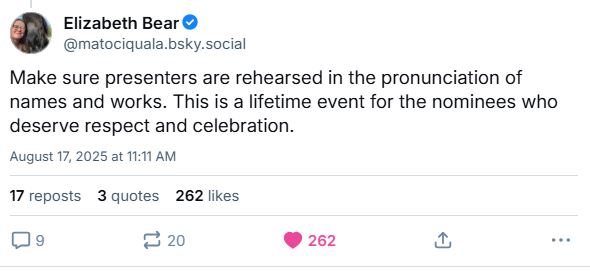
Aside from a Bluesky post by Elizabeth Bear, there has been no discussion, no articles, nothing beyond social media rumours. This is being relegated to the dustbin of history. An unfortunate faux pas. An oopsie.

I shall not let it fade away.

In the global forum that is the internet, I rank just slightly above a street preacher with a megaphone. I don’t expect this essay to be seen by more than a few dozen eyeballs. But my blog will live on for decades, and so will this contemporary record.


It’s 2015, Seattle, tech industry. Many of my coworkers are from India. Their culture fascinates me, as do their names. I take great care to memorize each arrangement of syllables, to commit to memory the names I’d never before encountered. Suyash, Vairavan, Srinivas, and many others. The sole Indian woman on my team is named Vijayalakshmi Deverakonda, and I’m in love with the melodious sound of her name, the way the syllables cascade off my tongue.

The rest of my white coworkers don’t share my respect for people’s names. They routinely call her “Vijay,” which is a male name, and more than a little insulting.

Within two years, Vijayalakshmi and I become workplace rivals. Afterward, we don’t stay in touch. But for a few months, I knew I’d made a fellow immigrant happy because I’d gone the extra mile to learn her true name, to treat her like a fellow human being.


Every failure can be explained by one of these two fundamental explanations: evil or stupidity. Malice or ignorance. It’s often hard to determine which of the two is the main factor. When people make assumptions, and when they build further assumptions on such shaky foundations, their ultimate conclusions diverge from reality.

I make no assumptions. I can believe that a celebrity of the literary world, the main announcer chosen by the 2025 Worldcon committee far in advance, was merely ignorant, and maybe nervous, but not evil.

I say this to myself, and then I remember that giggle in the middle of that unusual name.


Here is how to pronounce “Grigory Lukin.” The first name rhymes with “story.” It has nothing to do with the name “Gregory.” The last name rhymes with “win.” It does not at all sound like “looking.”

For the purposes of brevity, this essay will not cover the pronunciation of my consonant-rich patronym.


It’s 2017, Seattle, the same stressful tech company where white and Indian employees mingle but don’t mix. In a work chatroom, a fellow white guy makes a dirty joke about an Indian woman whose first name is Sukdeep.

I submit an HR report, as do several of my Indian workers. They’re surprised that I would care. To me, that’s a matter of fundamental human decency.

My white male coworker is a successful programmer. He gets a chat with HR, but suffers no further consequences.


The Hugo awards presenter is neither white nor male nor a programmer. But they are successful.


I live in Québec these days. Either here or in America, I can pass for a local, as long as I don’t open my mouth or show my ID. My Russian accent will never truly go away, and for as long as it stays with me, changing my name to something more Western-sounding would be futile. I shall always be The Other.

We rarely speak of this – we who have made a life for ourselves in the West, we who have fully integrated, we who have found a niche in this world. We rarely voice that deep-seated anxiety: do our new compatriots actually accept us? Or are we still viewed as The Other? Do they chuckle and mock our names when we’re not around? Do they bother to view us as fully human even as they enjoy our writing, our films, our art?

We’ll never know for sure. It shall forever be unknowable. Probably paranoia, nothing more.

And then the host of the most prestigious sci-fi and fantasy awards ceremony giggles while reading a foreign name, and the deep-seated anxiety flares up, and I think that maybe it’s not paranoia after all.


The importance of names is an ancient concept, perhaps even eternal. Even today, some cultures give their children a fake name to ward off evil spirits. Religious Jews don’t pronounce the four-letter name of God written in the Torah. Some cults insist on changing their followers’ names to separate them from their past. Many cultures automatically change women’s last names to those of their husbands. Residential schools were infamous for changing Native American children’s names as part of the forced assimilation process. In fairy tales around the world, through the ages, a villain could be defeated only if the hero learned and pronounced their true name.

And at the annual Hugo awards ceremony, the host giggles when they read an unusual name during the highlight of someone’s professional career.


Most issues can fit on a spectrum from one to ten.

Refusing to rehearse foreign names and then mangling them during an awards ceremony is more serious than a playground microaggression.

At the same time, it’s far less serious than a large-scale cultural genocide.

At the same time, it’s still on the spectrum.


Things you should do if you’re overwhelmed and nervous while presenting the most prestigious annual science fiction and fantasy award:

1. Take a few seconds to refer to your pronunciation guide.

1a. If a pronunciation guide is not available, demand one. Have the singers come back on stage to fill the gap until the guide is procured.

2. If the pronunciation guide doesn’t exist, take a few more seconds to summon somebody (perhaps even one of the singers!) to help you.

3. Apologize to the audience, invite every finalist to join you on the stage, and have them pronounce their own names into the microphone.

4. Apologize even more profusely. Admit your nervousness and lack of preparation. Give the microphone to somebody more qualified. Walk off the stage. Don’t return.


Things you should not do:

1. Don’t giggle.

2. Don’t goddamn giggle.


You may mock this essay, as is your right. In these turbulent times, as the planet gets ever hotter, as war crimes get more horrific, as genocides get swept under the rug, this is what people complain about?

And yes, sure, you’d be right. Saving even a single starving child from a sniper is infinitely more important than this issue, now and forevermore. And yet, if your first reaction was to scoff, consider this: is your name conventional? Do people ever giggle when they see it? Are you aware of the concept of microaggressions? Would you say you believe in equality, that racism is wrong, that diversity is important? When you claim to be an ally to those different from yourself, do you accept (both intellectually and emotionally) that they have certain issues which you cannot comprehend but should believe?


If there’s ever an apology letter from anyone involved, it’ll probably blame stress, and anxiety, and growing up in a social environment that didn’t have such linguistic diversity.

Over the past five days, there has been no such letter.

I’m prepared to accept that the main announcer (and their helper) was an anxiety-ridden human being, with human biases, with imperfections. I understand. There are eight billion people in this world. Quite a few of them have sins that are far worse than laughing at foreign names.


I don’t demand perfection. I demand basic competency.


This essay isn’t about the Hugo awards announcers. It’s about the stunning incompetence of the ceremony’s planners.

Here are some things I’d love to learn, but doubt I ever will:

  1. How many times did they rehearse the Hugo song?
  2. How many times did the announcers rehearse the names?
  3. Was there ever a pronunciation guide?
  4. If not, why?
  5. If yes, what happened to it?
  6. Was there ever, at any point of the planning process, a voiced objection, or even a concern, that the popular awards presenter would not be able to pronounce foreign names?
  7. If so, what was the reaction?

I’ve been a lifelong reader of science fiction and fantasy. I can go to great lengths to suspend my disbelief. But if you expect me to believe that a racist, homophobic, rural high school in one of the poorest states can find a professional name announcer, while a giant annual convention held in one of the most prosperous cities cannot… I’m sorry. Even I cannot suspend my disbelief that much.


Was the awards presenter chosen on the basis of friendship and connections and good vibes? Were they chosen because they had decades of experience in speculative fiction? Was there no one else available who had a richer linguistic and sociopolitical background?

Would it be fair to say that even if any concerns had been voiced at all, the overall sentiment was to dismiss them and hope for the best? Let’s just do it and be legends, man. We’ll do it live. Fingers and toes crossed. YOLO, eh. What’s the worst that can happen?

A system that awards top jobs based on seniority and connections rather than competency related to the job at hand ceases to be a system. It becomes a joke.


This essay is not about the US politics.


Throughout history, one of the worst and most unusual punishments was to have your name struck from historical record, as if you never existed at all.

Call it petty. Call it poetic. Call it neither, or both. I deliberately choose not to mention the name of the giggling name-mangler in this essay. Likewise for their co-host. It’s a bit ironic, since neither of them had actually introduced themselves when they started the ceremony. (Nice song, though.)

The announcer’s name will probably live on through all their many written works, but this essay will do them no such honour.

Names have power. Deleting them, even more so.


Someday, I hope to be a Hugo finalist. I’ve got about 35 years left; 40 if I eat my veggies. If I ever do get that honour, when my turn comes, will the announcer mangle my name? Will I be afforded the most basic human respect of an identity?

In this genre of dragons and werewolves and rocketships, this is my wildest, most improbable hope: that someday, we shall have awards ceremonies where people with unusual names will be treated as individuals.

May we live long enough to witness such wonders.


Notes and video excerpts:

  1. The well-rehearsed Hugo song: https://www.youtube.com/live/py7MeV31ln4?si=0AklpGZtEfv5Cu07&t=965 
  1. “They’ve given us a script, but I cannot find it”

“Right, there’s supposed to be a binder, right?” https://www.youtube.com/live/py7MeV31ln4?si=yh96eRIiOFmtsOhO&t=1220 

  1. The mispronunciation giggle: https://www.youtube.com/live/py7MeV31ln4?si=_zCF83ds59z_JVpQ&t=3387 
  1. Khōréō name list: “There’s a lot of them” [skipping the entire list of names after painstakingly reading the two prior lists of names] https://www.youtube.com/live/py7MeV31ln4?si=0zVwe8T1eXf-JrNB&t=3403 
  1. Mangling Denis Villeneuve’s name: https://www.youtube.com/live/py7MeV31ln4?si=ZSYncwfYiwyK4Rgh&t=4969 
  1. “I’m looking for my cheat-sheet before I say something that is difficult for me to say… Let us see… I don’t know if I have any pronunciation guides. Okay, I’ll just – I’ll be corrected when I’m wrong, okay?” https://www.youtube.com/live/py7MeV31ln4?si=_7rZwfn-l5988LjF&t=6061 
  1. “And this – I do not know how to say this, but you know how to say this”

“What? I do? I do not know how to say it because nobody gave me the pronunciation guide.” [referring to “Sheine Lende” by Darcie Little Badger, who went on to win the YA prize.] https://www.youtube.com/live/py7MeV31ln4?si=dL34349j1IKwgQKK&t=7655 

  1. Skipping “So Let Them Burn” by Kamilah Cole entirely after the confusion with “Sheine Lende” pronunciation:

“Did we miss one? Oh no! Why aren’t they on the list? … Clearly they have to win because they were on the second page.” https://www.youtube.com/live/py7MeV31ln4?si=nVOK4Ivqe0IB9D5d&t=7671 

  1. Elizabeth Bear’s Bluesky post on this topic: https://bsky.app/profile/matociquala.bsky.social/post/3lwm66nrzjt22 
  1. Related to the topic of names: a very beautiful short film about a rural woman and an eccentric foreigner with a hard-to-pronounce name, and their resulting friendship. “Meeting Mr. Oscar”  https://www.youtube.com/watch?v=QcbPCcpzQ1I 

Onward to Worldcon

Typing this up at 1:40am before catching some Zzz’s, a bit of packing, more than a bit of Tim Hortons, and a bus to the first of the two flights to Seattle, to the 2025 Worldcon.

This will be my first Worldcon and almost certainly not the last. I got here in such a roundabout way, too… Months ago, I was dying of boredom (a bit of a recurring theme, that) and, after playing with filters on FilmFreeway, I stumbled on Worldcon’s first-ever film festival. It hadn’t been advertised, and so it was just pure chance that I found it at all. Submitted my short film. Got accepted. Started thinking that if I’m going to attend in person, I might as well get the full week-long membership, not just the complimentary one-day ticket… And that’s how it came to be, eh. Life is a yarn ball of coincidences.

I’ll be in Seattle for six full days, at least four of which will feature post-Worldcon parties, and the sixth will have a barbecue right after a hike up one of the local mountains. (With a handful of other Worldcon attendees.) That should be fun… For extra fun, I’ll try to get up at 6am in order to be at a coffeeshop meet-ups (and one SFWA breakfast!) at 7-ish in the morning, for a chance to geek out with fellow SFF fans before the hustle and bustle of the convention.

On the off chance you’re reading this and have not yet finalized your Worldcon program – hey, come check out my film! Thursday, noon, room 331. It’ll be my third real-life screening, and it’ll be every bit as terrifying and exciting as the first two, I’m sure.

My sole regret is that I won’t be able to attend every single Worldcon panel – there are so many of them, and some of the really amazing-sounding ones overlap. Where’s a time-turner when you need one, eh?

This will be, without a doubt, the geekiest week of my life. Exactly 168 hours from now, I’ll be napping in Chicago’s O’Hare International Airport before my morning flight back to Quebec City: the first of many attempts to pay off the sleep debt I’m going to accrue in the coming days.

Can’t wait, eh.

Most advice comes in parables. The kind that doesn’t is straightforward: “don’t eat the yellow snow” or “use the bathroom before going outside.” Anything more complex than that, though… Parables. Lots and lots of parables.

You may have heard the same damn piece of advice dozens of times before, but someday it’ll sneak up on you, shaped and phrased and packaged as something entirely new, novel, and unexpected – and before you know it, you’re looking at the same problem from an entirely different perspective, and everything clicks in place.

Ever since finalizing the edits on my YA sci-fi novel “The Patron Saint of Unforgivable Mistakes” in April, I’ve been more or less procrastinating on writing my next novel. (Also sci-fi, but – for once – without any time travel whatsoever! I know, I’m just as shocked as you are.) The last three months haven’t been unproductive, mind you. I’ve written tons of new stories, attempted (and then quit) a huge hiking adventure, and joined the SFWA. (Huzzah! The screening process took just two days.) But despite assembling an impressive collection of factoids, cool epigraphs, and citations for my next novel, I never actually sat down to write it…

A blank page is perfect by default: it is pure, unsullied by substandard words, and filled with glamorous potential. But you can’t make a novel out of blank pages. You must sit down and actually write.

Not long ago, I was procrastinating by reading the writing advice from some of the best writers of our time. Among them was Octavia E. Butler, whose work ethic was legendary: she treated writing as a job, and wrote four hours a day, every day. (By my guesstimate, that puts her in the top 1% of writers or thereabout.) This page of advice had a section called “Don’t Prettify Your First Draft.” It had this very interesting bit of advice: “To her, the first draft wasn’t art. It was a raw material dump. Only after that could real craft begin. She followed what they call ‘vomit drafting.'”

The phrase “vomit drafting” was so over-the-top vulgar, obscene, and hilarious, that it got past all of my mental shields, all the laziness and procrastination. We’ve all thrown up at some point. A highly unpleasant and purely physical sensation, that. When you link that simple, brutal word with “writing” (an activity that has more mystique and unmet expectations attached to it than just about anything else) – well, the juxtaposition is nothing short of hilarious.

And that’s what did it for me. I’d read lots of different variations on the theme before: the first draft’s job is to exist, every first draft sucks, etc, etc. But this simple, plain, funny brutality – “vomit drafting” – was what ultimately worked for me.

And so… I pretended to turn off the part of my brain responsible for shame or self-esteem, and I sat down, and I just started typing. The codename for my novel is “Inhuman Insurance Inception” (the actual title is much snappier, I promise), and it’ll feature two different points-of-view, as well as lots of interesting, world-building interludes. (A bit like in “The Watchmen” graphic novel.)

I started writing 11 days ago, on July 22. Haven’t missed a day thus far. The total wordcount (the first POV + the interludes thus far) is 15,146 words, which is pretty damn great. (I’ve also managed to knock out at least one new short story along the way. Yay side quests!)

I’ll leave for Worldcon in 10 days and I’m not exactly sure whether I’ll be able to maintain my writing streak of 1,000+ words per day, but I know I’ll add at least a few new words to ye olde manuscript. And the entire time I write, I’ll imagine the late, great Octavia E. Butler sitting in the same room, typing on her own computer, the two of us vomiting our first drafts onto the hitherto pristine – and pure, and empty, and therefore unsellable – pages.

Give it up for parables, eh?

I love it when a bunch of things I’m juggling pay off all at once. To outsiders, that looks like magic. To me, that’s the result of a lot of work.

I’ve heard back from a few film festivals, and they want me in! There are a couple I’m not yet allowed to announce (because they give the filmmakers the good news before posting the results online), but the one I can absolutely mention here and now is the 11th annual Ridgway Independent Film Festival (RIFF), held in the beautiful Ridgway, Colorado. Never really been to Colorado (in some alternate universe, I’d be hiking through it right around now…), but I look forward to visiting it! The festival will be in mid-October. If any of you are around those parts, drop me a line – let’s hang out, eh.

Yesterday, I signed the contract for my sixth short story publication, huzzah! The story is “Hard as a Mirror of Cast Bronze” and it’ll run in Bullet Points magazine this October. The title comes from a Biblical allegory that tried to convey how futile it would be for a mortal to comprehend God-level plans. The premise of my story is somewhat similar: what if there was someone so brilliant, so off-the-charts great at integrating and weaponizing different fields of science, that she’d be destined to take over the world? Not only here, but in every single dimension. And what if an assassin sent to kill her found not yet another version of a megalomaniacal tyrant, but… someone entirely different? Wait till October to learn more!

After I signed that contract, that set off the final stage of my internal Rube Goldberg machine, because at that exact moment, I became eligible to join SFWA! (SFWA stands for Science Fiction and Fantasy Writers Association, aka the worldwide guild.) To join as an associate-level member, you need to prove you’ve earned at least $100 as a genre writer over the course of your life. Reader, I am very very proud to share that with this new story sale, my lifetime earnings equal exactly $100.78. Right past the finish line, woot! (It would’ve been funnier to land at $100.01, but I’ll take $100.78!)

And so… I filled out the long and detailed SFWA associate application yesterday, at long, long last, after many years of dreaming and planning and writing. It was a bit funny to encounter the “I am not a robot” checkbox during the application process. A very dry sort of pun, considering.

The form requested proof of earnings, of course. My sincerest apologies to the SFWA staffer tasked with reviewing and summing up all six contracts I uploaded. If you’re reading this, my SFWA friend, and if we ever meet, I’ll buy you a glass of water. (The annual membership fee is $100, leaving me exactly 78 cents. Heh. Good investment, though.)

Joining the SFWA will grant me access to what might be the most exclusive message board in the world, with decades-old archives of SFF writers talking about life, writing, and everything else. Also, access to SFWA convention suites. Also also, the ability to nominate (and vote) for the annual Nebula award. Also also also, a not-insignificant level of protection in the event something goes haywire with a writing contract. And much, much more… I hope my application goes through before this year’s Worldcon, which will kick off in just three weeks. As a filmmaker with a short film and a live screening, and as the (hopefully) newest SFWA member, that’ll be one helluva week!

And, to wrap this up with even more good news – I started writing my third sci-fi novel! (This one, in a surprising twist, will feature zero time travel. I know, I know.) I’ll keep the title secret for now, but the working title is… let’s call it “Inhuman Insurance Inception.” That more or less sums it up. It’ll be a multi-POV tale of the ethics of assimilation in general and first contact in particular. Aliens and humans. Hackers and webcams. The so-called civilized humans and the isolated tribes. And more…

So far, I’m 4,000 words in, with an outline and a lot of juicy quotable tidbits already prepared, and I’m going to shoot for 2,000 or so words per day. It’ll be easy, considering the plot has been boiling inside my brain for many many months. Should be fun, eh.

And with that… Gonna sign off, watch some surprisingly poignant reality TV (I know, I know…), and get ready for another day of writing.

Hope y’all are having a wonderful weekend.

WorldConputer-5000 reviewed the agenda. “Bring me Grrrr Martin!” it roared.

“But Your Highness, he perished in a tragic trampoline accident 27 years ago,” said Bobby the Intern just before his shock collar went off.

“Then bring what’s left of him!”

***

“…stupid Conputer. Stupid internship,” Bobby muttered under his breath as he pushed the gruesome cart through the dank tunnel.

“Shh. Someone may overhear,” said Inga as she stepped out of the shadows. Bobby liked her: she always decorated her shock collar with fresh flowers, a luxury from above.

They hugged the wall as a squad of Tesloids marched by. Each Tesloid was an LLC, and thus a corporation, and thus had more rights than a mere intern.

“Do you ever dream about, um, the future?” Bobby asked as he and Inga slowly pushed the cart.

“Only all the time,” she said with a rueful smile.

“I want to become a full citizen,” Bobby said, “but I can’t handle 25 more years of this.” He didn’t specify. He didn’t have to.

Inga put her left hand on his shoulder. “Well, we can always become writers.”

At that, a terrible shriek emanated from a deep tunnel.

“Someone missed a deadline again.”

“How did it ever get this way?” Bobby asked. Inga always knew things others didn’t.

“Ever hear of exponential growth?” she asked.

He shook his head.

“Well, it’s when something grows forever, without bounds. It can get out of hand pretty fast…” Her voice trailed off.

“What do you mean?”

“Let’s say there were 673 short story nominees in 2025,” Inga said.

“Okay.”

“And in 2026, that number went up by 15%.

“Sure.”

“And then someone centralized the Worldcon by building that monstrosity, and it demanded 15% more output each year.”

“But that’s… That’s…”

“Unsustainable, yeah.”

Their conversation was interrupted by a wretched-looking hairy creature wearing a burlap sack. It ran out of a side tunnel, clutching a filthy keyboard.

“You’ll never get me alive!” the feral writer shouted as three Tesloids gave chase.

They disappeared out of sight. No screams followed.

“Things can’t go on like this,” Bobby said once his heartbeat finally slowed down. “There must be something – anything – we can do.”

Inga stopped and gave him a slow, appraising look.

“Tell me,” she said slowly, “have you ever heard of time travel?”

“Pfft. Fairy tales,” he said with an eyeroll.

Inga’s expression didn’t change. Could it be… Was it possible this wasn’t a prank?

“No way,” he whispered, his eyes wide.

“I’m with the Resistance, Bobby. We have a working prototype. Join us – join me – go back in time, change this timeline.”

“…I’m in.”

“I knew you would be.”

THE END


This short story (flash fiction, really, at 443 words) was written completely spontaneously, when I got visited by a muse. (The muse took the form of a bowl full of pasta with ketchup. Mmmm, carb rush…) I was reading this excellent Bluesky thread by Abigail Nussbaum, a Hugo Award-winning critic and author. In her thread regarding the future of the Worldcon, she wrote, “One thing that the reactions to this thread have really crystalized for me is how amorphous the demand to centralize the running of the Worldcon actually is. After years of having this conversation, I still haven’t seen even a vague sketch of what it would look like.”

The words “even a vague sketch” inspired me, the first skeet came unbidden, and then, well… It was too much fun to stop at just one!

And now, dear reader, there is at least one vague sketch of what the centralized Worldcon would look like. (A very very unserious sketch, but a sketch nonetheless.) You can read my original skeet thread over here. (Yes, we call them “skeets” over yonder. No, we won’t change.)

…it would be pretty funny if after everything I’ve written, after all the sci-fi films I’ve made, this got nominated for the Best Related Work. Heh.

…by which, to be clear, I mean caffeine and sugar. Mostly caffeine, really. So much caffeine.

I know this is ultimately unhealthy, and I know that Brando Sando (allegedly) doesn’t even consume coffee, but he’s the unattainable ideal of us writers. (The man wrote a bunch of full-length novels in secret while writing his regularly scheduled books during the lockdown.)

On the other hand, there’s Stephen King and Philip K. Dick, both of whom abused hard drugs with gusto. King said there are entire novels from that part of his life that he simply doesn’t remember writing, and PKD’s output was legendary – until he died of stroke at 53. (To be fair, even goody-two-shoes folks can get fatal strokes, and it can’t be proven that the drugs played a part.)

And then there’s me, chugging an extra-large black coffee with a Tim Hortons donut, which had been preceded by a passable cup of coffee and an above-average slice of chocolate cake at a fun little coffee date… The nature of my creative fuel is almost hilariously geeky by comparison, but hey, if it works, it works.

During the long walk home (the damn bus strike – still – but also, the weather was perfect), an old seed of an idea finally sprouted and, well, I aim to spend the rest of the night typing up the first draft of my first foray into a horror story. (With heavy sci-fi elements, of course, because come on…) Then I’ll sleep on it (after binge-watching a few more episodes of Alone), apply several coats of edits and shoe-shine – and then it shall join the ranks of my as-yet-unsold short stories and start the big bounce between the genre magazines looking for this sort of thing.

And now… Time to type, eh.

If my eventual cause of death isn’t “misadventure,” I will be very very surprised. For anyone in the distant future trying to make sense of my life and/or to create a facsimile virtual mind (good luck with that, bud), this here is a fine example of one of the core parts of my personality…

Quebec City’s bus drivers are on strike. Again. This time, the strike is 13 days long, timed specifically to coincide with the gigantic annual music festival, FEQ. I had been under the (very wrong, very misguided) impression that the strike had ended. That was incorrect.

When I got up, my plan for the day was fairly simple, as those things go: take a leisurely 90-minute walk (yes, 90) to the local Ikea, enjoy their 50% off Thursday dining hall, get a few tiny parts for my bookshelf (each move takes its toll, eh), then take the bus to the tourist sector, return a couple of library books, pick a new book, then rush back to the bus to take advantage of the 90-minute bus pass window, and head home. Easy-peasy, right? Wrong.

The 90-minute hike went fairly well: I got to experience a new (and not very impressive) part my city firsthand, with my own feet and nose and eyes. The Ikea visit was only partially productive, but their diner was fine as always. And then… Well, then I realized I could either walk 90 minutes back home, or 150 minutes (that’s 2.5 hours) to the tourist sector (aka Old Quebec), followed by a two-hour hike home afterwards. Reader, I chose option B.

I have two legs, high stamina, and way too much stubbornness for my own damn good. (Incidentally, this is yet another reason women usually live longer than men.) If I went home, I might as well have postponed all my library-related plans for 96 whole hours, assuming the strike ended on schedule. I support the drivers’ right to strike, but I also refuse to stay put. My 2022 PCT thru-hike is partially to blame: after you walk from Mexico to Canada, from that point on just about anything is in walking distance. It’s only a matter of logistics, really.

And, well, that’s how I got my 56,800 steps for the day, aka 28.4 kilometers or 17.6 miles. With a roughly 10lb backpack on my back. Also got a damn fine dose of vitamin D, and a bit of a sunburn on my face, but it wouldn’t be the first time. (Though, admittedly, the contrast between my arms (currently a nice shade of brown) and the rest of my body (Snow White’s long-lost brother from another mother) is mighty hilarious.

No regrets. Ever.

In creative news, my debut film (Please Don’t Send Help) has been accepted by two film festivals! One has asked me to postpone the announcement till later (secrecy makes everything more exciting), and the other one is ReadingFilmFest, an annual film festival held in the town of West Reading, PA. I’ve never been to Pennsylvania in my life, so it’ll be exciting to attend that fest in person in October. (Their generous assistance with lodging is much appreciated!) I’ll make another post soon about my rather ambitious plans to make a film festival circuit of my very own… ReadingFilmFest was definitely part of that list. One down, many more to go!

And now, time to lean back, enjoy a big cold beer, and play some Stardew Valley to unwind… Aww yeah.

Been sleeping on the floor these past five weeks. This has been due to a very logical set of decisions culminating in a pretty eccentric conclusion. I wrote about it a few posts ago, but briefly: my attempted thru-hike from Mexico to Canada ended prematurely, all my things were in storage, and I still had my empty apartment’s lease till July 1.

Ipso facto, didn’t make much sense to deal with a moving truck for just a few weeks.As of right now, my studio apartment has one small cooking pot (no lid), one fork, one pocket knife (mangos are hard!), a small pile of clothes, a laptop, a cellphone, a few chargers, some hygiene stuff, and two empty backpacks. Oh, and the sleeping bag I use on the floorboards (I’m not a barbarian), though without a mat (I’m not a king). There are also kitchen appliances (fridge, freezer, stove), but they’re more or less a default setting for rentals.

And… that’s pretty much it. Since mid-May, I joined a nice little anglophone library, attended a book sale, and have acquired a small stack of books that I haven’t quite read yet. In other words, the usual routine has been reestablished.I like to think of myself as a minimalist with a bit of an art hoard, but this is mighty minimalistic even for me, eh. This strange little lifestyle design experiment has had some interesting outcomes…

For example, I don’t miss my art, or my cool gem and mineral collection. Not sure if that’s because I’d gotten so used to them over the years, or because mentally, I’m still in a flux over the failed thru-hike adventure. (Not bad, just weird; a lot of compulsive walking.)

I have internet access through my phone’s frankly exorbitant data plan, and I use my phone as a hotspot whenever I need to do something on my laptop. I’m not streaming anything because I want to preserve all those gigabytes, and I rather miss Netflix. And gaming, even though I realize how addictive that hobby is. (I literally dream of Skyrim.)

Ironically and unexpectedly, the thing I miss the most is radio. Just a plain old little radio-clock cube thingy that can be set to a local station, to babble at me in that beautiful blend that is the Quebecois French, because, frankly, it’s impossible to learn from any app. (The continental French is an entirely different animal.)

One objective improvement has been my productivity. With my desktop in storage, I haven’t made any new short films, but now I have so much time (and so few distractions) to simply write. Over the pasy five weeks, I’ve written five short stories. They range in length from 333 to 5,400 words, and one of them has already been accepted by a Canadian anthology, woooo! (More on that later, once the contract is signed.) Also, I’ve just signed the contract for another anthology – this one will be about superheroes, and will feature my February story “To Fly or Not to Fly.” (Inspired by my experience with bureaucracies and the time I jumped into traffic to save a feral toddler.) The other stories I’ve written recently (and earlier) are awaiting replies from a wide variety of magazines. There’s one particular (and major) magazine that has been sitting on my new submitted story for quite a while now… I’m cautiously optimistic, given that their usual turnaround time is just a day or two.

All in all, this has been the most productive stretch of my life, writing-wise. Perhaps it’s the near-isolation, or the sheer emptiness of my living space (my studio isn’t big, but it looks huge without 97% of my stuff), or the fact that the weather is finally good enough to go on looong walks (think 2-5 hours) without being threatened by the elements – just walking and thinking and meditating on new plots and absorbing random new experiences. (Quebec City didn’t get its T-shirt weather till late May. I love this town, but I swear, the spring is getting colder every year.)

Or maybe it’s none of those things, and the wacky desert adventure, where each day had more new experiences than a fortnight in this town, reshuffled my brain and finally helped me internalize the way the narrative process works. I had so many stranger-than-fiction encounters in that desert… I miss it.

Or maaaaybe the secret factor here is that I’ve been doing a helluva lot of reading. In addition to going through my gigantic “to read” list (it’s in triple figures!), I’ve also been devouring the Wolrdcon finalist packet. Worldcon is the biggest annual sci-fi/fantasy convention (held in Seattle this year), and since they picked me for their short film festival, I figured I might as well go for the full event, not just for one day. $275 bought me full membership privileges, the convention pass (it’ll be so much fun to finally meet all my favourite authors), and the PDF versions of all the short stories, novelettes, novellas, and novels (and many other categories) that made it to the final round of voting.

I take my newfound responsibility seriously, which is why I’m reading all of them. Every last one. They are delicious, eh. Currently almost done with Adrian Tchaikovsky’s “Service Model” – that novel is an absolute blast. (Think Wall-E mixed with Fallout.) I’ve literally laughed out loud – and often – while reading it. Five stars, highly recommended.

So, yeah, inspiration galore. About a week from now, I’ll move into my new apartment (it’ll have a balcony! but no bathtub…) and get all my things from storage, and my life will once again have Netflix, and video games, and other time magnets. Here is hoping the new habits will stick.

I spent a very long time anticipating the day when I’d be able to use this header. And, of course, then I wrote it three days too late. But hey, time is a flat circle, right? (In my defense, I’ve been doing a lot of celebrating, and even more editing and rewriting.)

My awesome new agent is Brandy Vallance of Barbara Bova Literary Agency. (The same agency that brought us “Ender’s Game” – wooo!) Brandy is an author-turned-agent, an expert in the craft of writing, and the best advocate and supporter an author could ever ask for. Together, we shall find the perfect home for “The Patron Saint of Unforgivable Mistakes.” (And then, afterwards, for “Time Traveler’s Etiquette Guide” – and many more to come!)

Brandy was one of the very first agents I queried when I started agent-hunting over a year ago. The query odyssey was long and convoluted, and this post is not about that. Some other day, perhaps. Suffice to say, I’m not merely happy that I’ve leveled up as a writer – I’m ecstatic that I won’t have to deal with query trenches ever again!

Being agented is… wild. It’s a wild feeling, eh. I don’t have the numbers (and I don’t think anyone does), but I guesstimate that only 1% (if not less) of the folks who finish their novel ever end up agented. From what I’ve heard, it’s gotten even more difficult after covid. Some think that’s because millions of people had a chance to finally write their novel during the lockdown. Others blame ChatGPT: when anyone can generate a bunch of slop in a single afternoon, the number of queried novels goes way up, resulting in severe bottlenecks.

Whatever the case, it feels so strange – though in a good way – to be an actual agented writer. That’s not something you can buy, not something that’s awarded based on your looks or height – that’s based on merit. I’d started tinkering with my first novel way back in 2015, and didn’t finalize it till 2024. The novel Brandy and I will focus on had taken me just eight months to brainstorm, write, and edit. (Yes, that timeline is pretty symbolic, I know.) Between 2015 and now, I tried my hand at quite a few short stories, some of which actually got sold. I’ve been writing non-fiction Kindle e-books since 2011, and while they are, well, not fiction, that also gave me a fair bit of practice.

I’ve never taken a writing course, though I do have a growing collection of books on the craft of writing. (My top two recommendations are Chuck Palahniuk’s “Consider This: Moments in My Writing Life After Which Everything Was Different” and Damon Knight’s “Creating Short Fiction.”) I don’t know a single person even remotely close to the publishing industry. I’ve never been to writing workshops or retreats, and I can’t even imagine what goes on in MFAs. I’ve never been to a writing conference, and the only real-life pitch I’ve ever done was during a small panel at last year’s New York Comic Con – something I’d found completely by accident. (The feedback I got after my 60-second speech? “…I like the title.” Oof.)

I’ve been a lifelong reader, though, and a careful learner, with lots of time to think and brainstorm.

My method was simple: I just sat down and forced myself to overcome my hesitation and my self-doubts, and then I started writing. Perhaps not every day (though I tried to), and with a lot of outlines, powered by stubbornness and perseverance – because waiting for a muse didn’t prove to be a reliable strategy. And then… I developed a very thick skin: some of the rejections were hurtful; many queries just got ghosted, without even a token reply. I spent a lot of time spent querying, and revising my novels, and keeping the wordcount below 100,000. And I was patient. Very, very patient.

And even then success is never guaranteed. The nudge for my new novel (think “Ender’s Game” x “Chernobyl” x “The Umbrella Academy”) came from the most unexpected and unlikely source, though that’s a whole different story. If not for that, “The Patron Saint of Unforgivable Mistakes” might never have been written.

So if you’re currently in the query trenches, and you’re reading this… I don’t have the secret recipe, or the secret sauce, or a $9.99 book of advice that would boost your chances. You almost certainly already know all the advice I’ve mentioned. There’s nothing I can do to actually help you with your query, but I hope you will find some solace and encouragement in my words. I was just a guy, and then I started writing, and it took me a very long time, but I got signed. I’m not so insensitive as to say, “If I could do it, then anyone can do it” – but I hope my example will give comfort to other outsiders, to other folks who have no credentials beyond their love of fiction and their penchant for writing.

Onward, eh.

Ever onward.

There’s a fairly old video game, Red Dead Redemption, and it has a beautiful theme song… The lyrics are beautiful, but this bit in particular always resonated with me:

“And all the storms you’ve been chasin’
About to rain down tonight.”

The sum total of long-term plans, all coming to fruition at the same time. This week has been like that for my writing endeavours.

First, the Pulp Asylum magazine bought my short story “Murder of the Orient Express” (of, not on). After that, Story Unlikely bought the reprint rights to my very first sold story, “How to Prepare for Time Travelers in the Workplace.” And last but not least, I’ve sold my first-ever non-fiction work! My essay “The Hierarchy of Apocalypses” will appear in an upcoming issue of Phano. It’s about my video game escapism during the pandemic, and the many, many ways we as a society have chosen to outsource our humanity to machines. I’ve written quite a few non-fiction Kindle books before, but this is the first actual non-fiction essay sale. Hopefully, the first of many!

Also, I’ve finished yet another short film! That particular project is still top-secret, but it is – for once – not sci-fi, and it deals with a quixotic astronaut. Gonna add a few finishing touches and then try my luck submitting it to some A-list festivals. (The odds may be against me, but I have infinite time and optimism.)

Needless to say, this week has been one long series of celebrations. It’s a good thing I’m trying to gain as much weight as possible for my upcoming Continental Divide Trail adventure. (I fly out in just 17 days, wooo!) And on top of that, I have a very very enthusiastic agent reading my new novel (“The Patron Saint of Unforgivable Mistakes”), and a few more stories submitted to anthologies – which have not yet been rejected on sight. (That’s always a good sign!)

I can’t quite describe how great this feels: after months of rejections, receiving three acceptance emails (and on the same week!) is an unbelievable dopamine boost.

I track all my story submissions (and rejections) in a plain old text file – that’s fast and easy. At this point, I’m starting to run low on the unsold stories, which is an excellent problem to have! I’m currently reading the wonderful “Creating Short Fiction” by Damon Knight – reading it slowly, because (unlike so many writing guides…), it’s choke-full of advice and food for thought. The goal is to read it and internalize its lessons (or most of them, anyway) before my big CDT hike. I won’t have a lot of free time on my adventure, but I’ll have some – and I’ll have many many hours of nothing but hiking, and thinking, and brainstorming. This isn’t one of my primary goals for the hike (and not even in the top-5), but I suspect I’ll finish it with quite a few new short stories and poems. We’ll see, eh.

Here is to more acceptance letters from editors!