
It’s August 16, 2025, Worldcon, Seattle, and the main presenter of the annual Hugo awards butchers almost every foreign name on the list. When trying to pronounce an unusual African name, the presenter giggles.
It’s 1934, and Frank Lloyd Wright designs his masterpiece, Fallingwater. The beautiful house sits over a waterfall. To an outside observer, it’s a marvel of architecture, a fusion of engineering and nature. To the people who actually live there, it’s an endless nightmare of leaking roofs and cracked concrete. Fallingwater’s owner nicknames it “Rising Mildew.”
The 2025 Worldcon had hundreds of panels and thousands of attendees. It had fantastic freebies and fanfic fans and fun filking. It had authors and poets and filmmakers and podcasters. It had five full days of genre celebrations, of coming together as one.
It also failed at its most basic, fundamental purpose.
The cornerstone of this annual gathering is the Hugo awards ceremony. During the days leading up to the big event, the convention attendees engage in quiet discussions about the nominees. They wish their favourite authors the best of luck. They recommend the finalist books and art to all their friends.
And then… Then the esteemed Hugo awards host (as well as the secondary host) mispronounces non-English names, over and over. (Even Denis Villeneuve wasn’t spared.) They skip one of the nominees altogether, making the audience shout in unison, after which there is some awkward fumbling. (“Did we miss one? Oh no! Why aren’t they on the list? … Clearly they have to win because they were on the second page.”)
(That nominee did not win.)
The skipped nominee was Kamilah Cole, a Jamaican-born woman, whose only fault, it seems, was having her name on the second side of a page. (Typing on both sides of the page is a brand new technological development. Very few people have heard of it. We cannot expect mere Hugo awards hosts to keep up with such groundbreaking inventions.)
A house is supposed to keep you safe and dry, even when – or perhaps especially when – it doubles as a work of art. If it can’t do that bare minimum, it becomes worse than useless. It turns into a liability.
Likewise, an annual awards ceremony that fumbles that most basic of all tasks – pronouncing the finalists’ names – fails at its most basic purpose.
It’s May 2004, rural Nevada, high school graduation. The kind of school where many students get pregnant before they get their diploma. The kind of school where the biggest scandal of the year is the video of two boys kissing at a house party. The kind of school where the History teacher stops in the middle of a joke, chuckles, and says, “I’ll finish it later” when he realizes one of the school’s three Black students is sitting in the back of the class. The kind of school where all the students get lined up against the wall every few weeks, while a gigantic German Shepherd sniffs each crotch, presumably seeking drugs, and its handler, a gun-wielding cop, smirks.
It’s that kind of school. In a small desert town with one big street, one Walmart, and more casinos than libraries.
And as the graduation ceremony approaches, I worry that the announcer will butcher my name, just like most of my American classmates have during my sole year with them. The big day comes, and I’m beyond amazed when the announcer makes sure to ask each senior how to pronounce their name – and then gets all of them right, including mine.
Beneath the bright lights, on that stage, I get the ceremonial piece of paper and hear my true name. Few people clap: they’re so used to mangling my name that they literally can’t recognize me. No matter. I exit, stage right. Less than three months later, I leave for college. I never return.
The Hugo awards ceremony features a somewhat elaborate song number, with multiple people (including the awards presenters) singing in unison, at length, repeatedly. At one point, they even get the audience to join in.
There’s a very good chance they’d spent more time rehearsing that song than the names of the finalists, for whom this awards ceremony may well have been a once-in-a-lifetime opportunity.
During the ceremony, both of the main announcers say – repeatedly – that they don’t have a pronunciation guide for the names.
Five days later, there is still no official statement from the organizers. The announcer who giggled at the African name is silent on social media.
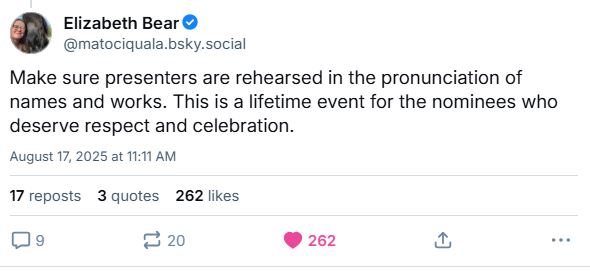
Aside from a Bluesky post by Elizabeth Bear, there has been no discussion, no articles, nothing beyond social media rumours. This is being relegated to the dustbin of history. An unfortunate faux pas. An oopsie.
I shall not let it fade away.
In the global forum that is the internet, I rank just slightly above a street preacher with a megaphone. I don’t expect this essay to be seen by more than a few dozen eyeballs. But my blog will live on for decades, and so will this contemporary record.
It’s 2015, Seattle, tech industry. Many of my coworkers are from India. Their culture fascinates me, as do their names. I take great care to memorize each arrangement of syllables, to commit to memory the names I’d never before encountered. Suyash, Vairavan, Srinivas, and many others. The sole Indian woman on my team is named Vijayalakshmi Deverakonda, and I’m in love with the melodious sound of her name, the way the syllables cascade off my tongue.
The rest of my white coworkers don’t share my respect for people’s names. They routinely call her “Vijay,” which is a male name, and more than a little insulting.
Within two years, Vijayalakshmi and I become workplace rivals. Afterward, we don’t stay in touch. But for a few months, I knew I’d made a fellow immigrant happy because I’d gone the extra mile to learn her true name, to treat her like a fellow human being.
Every failure can be explained by one of these two fundamental explanations: evil or stupidity. Malice or ignorance. It’s often hard to determine which of the two is the main factor. When people make assumptions, and when they build further assumptions on such shaky foundations, their ultimate conclusions diverge from reality.
I make no assumptions. I can believe that a celebrity of the literary world, the main announcer chosen by the 2025 Worldcon committee far in advance, was merely ignorant, and maybe nervous, but not evil.
I say this to myself, and then I remember that giggle in the middle of that unusual name.
Here is how to pronounce “Grigory Lukin.” The first name rhymes with “story.” It has nothing to do with the name “Gregory.” The last name rhymes with “win.” It does not at all sound like “looking.”
For the purposes of brevity, this essay will not cover the pronunciation of my consonant-rich patronym.
It’s 2017, Seattle, the same stressful tech company where white and Indian employees mingle but don’t mix. In a work chatroom, a fellow white guy makes a dirty joke about an Indian woman whose first name is Sukdeep.
I submit an HR report, as do several of my Indian workers. They’re surprised that I would care. To me, that’s a matter of fundamental human decency.
My white male coworker is a successful programmer. He gets a chat with HR, but suffers no further consequences.
The Hugo awards presenter is neither white nor male nor a programmer. But they are successful.
I live in Québec these days. Either here or in America, I can pass for a local, as long as I don’t open my mouth or show my ID. My Russian accent will never truly go away, and for as long as it stays with me, changing my name to something more Western-sounding would be futile. I shall always be The Other.
We rarely speak of this – we who have made a life for ourselves in the West, we who have fully integrated, we who have found a niche in this world. We rarely voice that deep-seated anxiety: do our new compatriots actually accept us? Or are we still viewed as The Other? Do they chuckle and mock our names when we’re not around? Do they bother to view us as fully human even as they enjoy our writing, our films, our art?
We’ll never know for sure. It shall forever be unknowable. Probably paranoia, nothing more.
And then the host of the most prestigious sci-fi and fantasy awards ceremony giggles while reading a foreign name, and the deep-seated anxiety flares up, and I think that maybe it’s not paranoia after all.
The importance of names is an ancient concept, perhaps even eternal. Even today, some cultures give their children a fake name to ward off evil spirits. Religious Jews don’t pronounce the four-letter name of God written in the Torah. Some cults insist on changing their followers’ names to separate them from their past. Many cultures automatically change women’s last names to those of their husbands. Residential schools were infamous for changing Native American children’s names as part of the forced assimilation process. In fairy tales around the world, through the ages, a villain could be defeated only if the hero learned and pronounced their true name.
And at the annual Hugo awards ceremony, the host giggles when they read an unusual name during the highlight of someone’s professional career.
Most issues can fit on a spectrum from one to ten.
Refusing to rehearse foreign names and then mangling them during an awards ceremony is more serious than a playground microaggression.
At the same time, it’s far less serious than a large-scale cultural genocide.
At the same time, it’s still on the spectrum.
Things you should do if you’re overwhelmed and nervous while presenting the most prestigious annual science fiction and fantasy award:
1. Take a few seconds to refer to your pronunciation guide.
1a. If a pronunciation guide is not available, demand one. Have the singers come back on stage to fill the gap until the guide is procured.
2. If the pronunciation guide doesn’t exist, take a few more seconds to summon somebody (perhaps even one of the singers!) to help you.
3. Apologize to the audience, invite every finalist to join you on the stage, and have them pronounce their own names into the microphone.
4. Apologize even more profusely. Admit your nervousness and lack of preparation. Give the microphone to somebody more qualified. Walk off the stage. Don’t return.
Things you should not do:
1. Don’t giggle.
2. Don’t goddamn giggle.
You may mock this essay, as is your right. In these turbulent times, as the planet gets ever hotter, as war crimes get more horrific, as genocides get swept under the rug, this is what people complain about?
And yes, sure, you’d be right. Saving even a single starving child from a sniper is infinitely more important than this issue, now and forevermore. And yet, if your first reaction was to scoff, consider this: is your name conventional? Do people ever giggle when they see it? Are you aware of the concept of microaggressions? Would you say you believe in equality, that racism is wrong, that diversity is important? When you claim to be an ally to those different from yourself, do you accept (both intellectually and emotionally) that they have certain issues which you cannot comprehend but should believe?
If there’s ever an apology letter from anyone involved, it’ll probably blame stress, and anxiety, and growing up in a social environment that didn’t have such linguistic diversity.
Over the past five days, there has been no such letter.
I’m prepared to accept that the main announcer (and their helper) was an anxiety-ridden human being, with human biases, with imperfections. I understand. There are eight billion people in this world. Quite a few of them have sins that are far worse than laughing at foreign names.
I don’t demand perfection. I demand basic competency.
This essay isn’t about the Hugo awards announcers. It’s about the stunning incompetence of the ceremony’s planners.
Here are some things I’d love to learn, but doubt I ever will:
- How many times did they rehearse the Hugo song?
- How many times did the announcers rehearse the names?
- Was there ever a pronunciation guide?
- If not, why?
- If yes, what happened to it?
- Was there ever, at any point of the planning process, a voiced objection, or even a concern, that the popular awards presenter would not be able to pronounce foreign names?
- If so, what was the reaction?
I’ve been a lifelong reader of science fiction and fantasy. I can go to great lengths to suspend my disbelief. But if you expect me to believe that a racist, homophobic, rural high school in one of the poorest states can find a professional name announcer, while a giant annual convention held in one of the most prosperous cities cannot… I’m sorry. Even I cannot suspend my disbelief that much.
Was the awards presenter chosen on the basis of friendship and connections and good vibes? Were they chosen because they had decades of experience in speculative fiction? Was there no one else available who had a richer linguistic and sociopolitical background?
Would it be fair to say that even if any concerns had been voiced at all, the overall sentiment was to dismiss them and hope for the best? Let’s just do it and be legends, man. We’ll do it live. Fingers and toes crossed. YOLO, eh. What’s the worst that can happen?
A system that awards top jobs based on seniority and connections rather than competency related to the job at hand ceases to be a system. It becomes a joke.
This essay is not about the US politics.
Throughout history, one of the worst and most unusual punishments was to have your name struck from historical record, as if you never existed at all.
Call it petty. Call it poetic. Call it neither, or both. I deliberately choose not to mention the name of the giggling name-mangler in this essay. Likewise for their co-host. It’s a bit ironic, since neither of them had actually introduced themselves when they started the ceremony. (Nice song, though.)
The announcer’s name will probably live on through all their many written works, but this essay will do them no such honour.
Names have power. Deleting them, even more so.
Someday, I hope to be a Hugo finalist. I’ve got about 35 years left; 40 if I eat my veggies. If I ever do get that honour, when my turn comes, will the announcer mangle my name? Will I be afforded the most basic human respect of an identity?
In this genre of dragons and werewolves and rocketships, this is my wildest, most improbable hope: that someday, we shall have awards ceremonies where people with unusual names will be treated as individuals.
May we live long enough to witness such wonders.
Notes and video excerpts:
- The well-rehearsed Hugo song: https://www.youtube.com/live/py7MeV31ln4?si=0AklpGZtEfv5Cu07&t=965
- “They’ve given us a script, but I cannot find it”
“Right, there’s supposed to be a binder, right?” https://www.youtube.com/live/py7MeV31ln4?si=yh96eRIiOFmtsOhO&t=1220
- The mispronunciation giggle: https://www.youtube.com/live/py7MeV31ln4?si=_zCF83ds59z_JVpQ&t=3387
- Khōréō name list: “There’s a lot of them” [skipping the entire list of names after painstakingly reading the two prior lists of names] https://www.youtube.com/live/py7MeV31ln4?si=0zVwe8T1eXf-JrNB&t=3403
- Mangling Denis Villeneuve’s name: https://www.youtube.com/live/py7MeV31ln4?si=ZSYncwfYiwyK4Rgh&t=4969
- “I’m looking for my cheat-sheet before I say something that is difficult for me to say… Let us see… I don’t know if I have any pronunciation guides. Okay, I’ll just – I’ll be corrected when I’m wrong, okay?” https://www.youtube.com/live/py7MeV31ln4?si=_7rZwfn-l5988LjF&t=6061
- “And this – I do not know how to say this, but you know how to say this”
“What? I do? I do not know how to say it because nobody gave me the pronunciation guide.” [referring to “Sheine Lende” by Darcie Little Badger, who went on to win the YA prize.] https://www.youtube.com/live/py7MeV31ln4?si=dL34349j1IKwgQKK&t=7655
- Skipping “So Let Them Burn” by Kamilah Cole entirely after the confusion with “Sheine Lende” pronunciation:
“Did we miss one? Oh no! Why aren’t they on the list? … Clearly they have to win because they were on the second page.” https://www.youtube.com/live/py7MeV31ln4?si=nVOK4Ivqe0IB9D5d&t=7671
- Elizabeth Bear’s Bluesky post on this topic: https://bsky.app/profile/matociquala.bsky.social/post/3lwm66nrzjt22
- Related to the topic of names: a very beautiful short film about a rural woman and an eccentric foreigner with a hard-to-pronounce name, and their resulting friendship. “Meeting Mr. Oscar” https://www.youtube.com/watch?v=QcbPCcpzQ1I
 Grigory Lukin.com
i was in the audience and so shocked they seemed to not have done a single run through (other then the song) of any category. Other award shows prerecord the nominees and have the presenter just read the winner. Yes some of those lists were long list of people’s names but why did some get the full read? I love watching award shows of all kinds but this one just bummed me out
Indeed… The best bad simile I can come up with is that infamous Fallingwater house: form and function must coexist. That award ceremony was all form, no function.
thank you for this sadly necessary essay. It was beautiful. I wonder if you could change the word Talmudic to “religious”? A Talmudic Jew isn’t really a thing, but it’s something we get called. Thank you.
I’ve learned something new today – thank you! 🙂 One edit coming right up.
thank you!! ❤
I think the ‘this is unimportant compared to starving children’ argument is easily countered by the fact that the entire ceremony, indeed the WorldCon itself is unimportant by that measure, and yet we decide it should exist. And since the only reason for an award is to recognise the author, getting their name right is job 1
In the grand scheme of things, almost everything is unimportant compared to starving children, and if the objection was raised by someone who themselves spends most of their time and energy working to eradicate childhood starvation, then they’d have a point. Somehow, it’s never those people who raise the point (for one thing, they’re too busy feeding children).
Most of us can hold more than one idea in our head, and, yeah, some of them are less urgent than others, but it’s not as if the existence of one problem invalidates any concerns about less earth-shattering ones.
I agree completely. I included that paragraph to preempt the all-too-common concern-troll objection.
I just wanted to say that your essay means a lot to me. I am polish and I have emigrated to the west. Having people constantly mock and mispronounce my name is driving me crazy – and as I am often the only slavic person in a diverse multicultural room, only I get this treatment. I don’t think anyone has ever tried to get my full name right, and it has also been butchered by announcers during ceremonies. Its such a small thing but it hurts so much.
I’m so very very sorry to hear that, P.A. You’re not alone. 🥲
This is a great essay, and beautifully written! I should point out that Bears wasn’t the only voce on BlueSky calling this out. A great many of us were appalled at what happened, and there as been a lot of discussion, and it’s still happening.
The disrespect shown on that stage was egregious, and it made me embarrassed to be part of the community. We think ourselves better than this, and yet it keeps happening. We can do better, we must do better.
Getting the names of the people whose names are the ones being celebrated is disrespectful, it’s rude and it shows nothing but contempt for the nominees and winners.
And it really isn’t just about the organisers (though they shoulder a lot of the responsibility). The hosts have known they were hosting the ceremony for well over a year. The list of nominees were made public in March – 4.5 months before the ceremony. There was time to get it right.
Thank you for your kind words! 🙂 The way I write is perhaps unusual, or maybe I just haven’t encountered many fellow plotters. An idea gets stuck in my mind, and then bounces around, harassing both of my neurons 😉 while getting refined and brainstormed and reshaped. I’m not joking when I say that takes up most of my brainpower… And eventually, I can’t take it anymore, so I just sit down and type with all the style and panache of the keyboard_cat.GIF hahaha. After that, a few editing passes, and out it goes. This particular essay had been on my mind for five whole days… I’m blown away by all the attention it’s received. (7,810 views in just 24 hours!!)
And yes, that’s a great callout that Bear wasn’t the only one who wrote about that. I tried to find others like her on Bluesky, but I guess the terms “Hugo”+”name” didn’t appear in a lot of skeets… Folks have since given me links to a few other blogs that wrote about the name-mangling. I’m happy to know I’m not alone.
I feel your pain. My last name is Knutson; has been for almost 64 years. I heard it pronounced incorrectly untold times.
The K is not silent. It’s not Knute Rockne.
It’s pronounced Ka newt son. My favorite is when they switch the first n and the u. Kuntson. Hard for people in the South to pronounce.
Oof, I am so so sorry. The sum total of those microaggressions (be they intentional or otherwise) over the course of a lifetime… That sucks. 😦
Wow… Just wow. As an RC race director, if I don’t know how to pronounce someone’s name, I ask them. It’s just common courtesy.
You’d think so, right? Also, I hate to be the bearer of bad news, but you’re overqualified to be a Hugo awards announcer. 😉
I love this essay but want to point something out. Even you are framing non-Anglo and non-Greek names as “unusual” and “unconventional.” Unusual to whom? Surely not the people whose cultures they belong to. I would suggest restating those things so that you’re not unintentionally supporting the framework you mean to see torn down.
Again, “hard to pronounce” is subjective, not a given.
Thank you for your comment – it gave me a lot to think about. 🙂
I’d argue that even Greek names are mangled: it definitely happens a lot to my Greek in-laws (by way of my sister’s husband), even in New York.
When I wrote “unusual” and “unconventional,” I meant in relation to the monolingual, non-linguistically-curious Western population. Thinking some more on this, there’s no single sociopolitical marker for it. Trailer-dwelling rednecks fall into that category, but so do well-off and highly educated awards presenters who are definitely not white men. (And, of course, GRRM did the same back in 2020…)
I intended no offense or disrespect with my phrasing. Thank you for pointing that out. 🙂
Your essay is wonderful, but your derogatory description of people who live in trailers has no business being anywhere near an essay that is about basic human decency. There are better ways to say that a thing is not defined by economic level. As a US emigrant, I look at things mostly as an outsider—a time-honored effect of being an immigrant-—and those words jumped right out at me—especially as our Traveller population is burdened with similar sentiments.
We may have to agree to disagree. They say to write what you know. I did. That’s based on my lived experience across many small communities all over the US – not just that tiny desert town.
As someone who wrote a more angry version of this essay five years ago, thank you for speaking up. I hope you’re treated better by fandom than I was.
I wondered if you’d seen this yet. ❤
The same thing happened with the r/fantasy names, too: https://www.youtube.com/live/py7MeV31ln4?si=6lBBCqCp4iNtI9pL&t=5725
I remember that too – it was so ridiculous and deeply unfair… Part of me wonders if that was at least in part due to some deep bias against social media, the same way some old-timers hated that the AO3 folks joked about each of them getting 0.001 of a Hugo.
I have the privilege of a well-known given name in the Anglophone world, but it is regularly mangled by Francophones.
I take care, when possible, to spell correctly and pronounce as correctly as I am able the names of anyone I meet either socially or professionally.
This is something I see as basic decency, so I don’t expect any praise for it. Yet I find that I am in a minority. When a colleague suggests that we should use a simplified version of her name or another calls himself by a fake English name, I cringe within.
Yet there is an advantage. The goodwill I receive exceeds the effort I expend by an astonishing margin.
Indeed! The ratio of goodwill-to-effort is amazing – and, in a just and better world – shouldn’t be notable at all. One of my favourite parts of the Murderbot show (in the books, too, but the show displayed it so much better, imho) is the near-utopian society those goofy scientists live in. To us, they may seem as over-the-top hippies, but I suspect – and hope – that in the future, more people will be like that. Respecting each other’s names and pronouns, willing to discuss their emotions and misunderstandings, etc…
Our world is not quite there yet. Very very far from it, actually. And yet I hope this type of discourse will push folks in the right direction, will open eyes and minds.
Brilliant writing indeed – I hope you get that Hugo nomination some day; you will surely have mine next year. I am very glad now that I got to meet you in Seattle.
Thank you so much. 🙂 Folks on Bluesky (whom I’m pretty sure I’ve never even met) have already floated the idea of nominating this essay in the “Best Related Work” category, and frankly, I’m blown away. Wasn’t being facetious when I wrote there’d probably be just a few dozen readers. Mind-blowing, the lot of this. 🙂 (Also, I guess I’ll postpone my sci-fi webcomic for next year instead of this year, then. 😉 )
This is one of the reasons I started a project to ask people with Wikipedia articles to record themselves pronouncing their names
https://en.wikipedia.org/wiki/Wikipedia:Voice_intro_project
That is such an excellent idea. Major kudos to you for doing this!
https://school.teachingbooks.net/pronunciations.cgi is a long-running project to cover at least the written and drawn part of the world.
That’s neat, but does not seem to be using an open licence, limiting its reusability.
Here’s an essay by someone else who was appalled by the Hugo’s. The first part is a trip report, but the second part is a scathing indictment of the program.
https://corabuhlert.com/2025/08/18/some-comments-on-the-2025-hugo-winners-with-bonus-tall-ship-pho
As others have noted, this isn’t the first time a Hugo Awards program has gone wrong. And what I can’t figure out is this: This community is full of folks with theater backgrounds, with presentation experience, and people who can crowd-source things like name pronunciation if the nominees aren’t available to provide instruction. What the hell happens when this much goes wrong all at once? There’s no doubt that a lot of work goes into these presentations, but if basics like a reliable script and name pronunciation are ignored in the presence of fans and the press, one wonders how seriously the convention takes what is supposed to be a prestigious event.
I saw Cora’s essay after I posted my own. She’s amazing, and her writing rocks. 🙂
You bring up a very good point… I would love for there to be a Fyre Festival-style documentary that would try to get to the bottom of this, because the silence speaks volumes. Over on Bluesky, the main presenter posted that they were “high as a kite on pain meds” and the second presenter wrote that she has covid and will issue a joint statement with the first presenter later. Nothing at all from Worldcon’s organizers, despite a lively discussion on their Discord. Ah well.
I don’t know how much theater background the two presenters have. I do know that it’s very very important to maintain the balance between form and function. If it flips 0-100 toward function, you’ll end up with gigantic and ugly concrete apartment buildings, like the one I grew up in back in Tomsk. Perfectly functional, but terrible for any sort of aesthetics or relaxation. (Consider how and where our species evolved.) Conversely, if you flip it 100-0 in favour of form over function, you’ll end up with Fallingwater: beyond beautiful, but utterly useless.
The same sort of thing happens in every field. Things like a beautiful perfume bottle shaped like a grenade, which is impossible to balance. (Britney Spears’s perfume, if I recall correctly.) Or a billionaire’s private submarine: all status symbol, with no safety features. Or Apple’s iPad, which for many many years didn’t have the basic calculator app because the late Steve Jobs thought the app’s design was too ugly to mar his creation. (And even after his death, it took them years to finally override his veto.)
And likewise here… I can absolutely see how folks can get carried away with adding more and more oomph and glitter to make the event more fun, more fancy… And while doing so, they would utterly forget the most basic reason for the event. It’s entirely possible that at least one organizer had concerns, but with the human nature being what it is, they may have felt too shy to go against the crowd. To be clear, this is all speculation on my part. (See also: the reason presidential advisers refuse to invoke the 25th Amendment even when really ought to: people, on average, are too nice, too conflict-avoidant.)
I really really want to find out what really happened… For example, when the younger presenter said, “I shouldn’t have given you that gummy backstage” to the older presenter, was that a joke?.. But given how silent everyone is on this issue, I strongly suspect (again, speculation) that any statement we receive will have been crafted by a committee – admitting nothing, avoiding everything.
I will be happy to be proven wrong.
Sadly, I predict you will not be proven wrong. So many things about the Seattle Worldcon were embarrassing, baffling failures – or worse. No water for the concert room, or the panelists?! No con suite at all? The masquerade fiasco with one contestant falling off the stage and all contestants being confined in their costumes for several hours? So much fail! A friend who’s a veteran of dozens of Worldcons stated that if this had been his first Worldcon, it would also be his last. It WILL probably be my last. The cost of every Worldcon I’ve attended is steep, the accessibility marginal, and when I’ve brought up such concerns I’ve been dismissed or gaslit. I guess I’m just not their target demographic. Btw, to take a stab at pronouncing your name, is it Grih-GOR-ee LOO-kin? That’s how my limited experience with Eastern European languages thinks it would be pronounced.
It’s fascinating how one huge event can have so many different viewpoints. I hadn’t heard about most of the things you mentioned, since my Worldcon consisted mostly of bouncing between panels and parties, while crashing at a friend’s place in northern Seattle. 🙃
I thought panelists all got special metallic-looking Dasani water bottles, but I could be wrong. The masquerade thing sounds low-key horrifying!
I’ve heard through the grapevine that the organizers of the 2026 Worldcon have read my essay and are very very mindful of pronunciation guides… I hope you’ll give it a chance, but if not, I understand.
Also, you got my last name wrong. 🙂 The emphasis is on the second syllable: it rhymes with “win.”
They gave me a pronunciation sheet for the Best Artist award that I presented. For the one that they weren’t sure of (“Say” or “Kay”), I went online on my phone during the prereception and googled it. I believe I mispronounced one of the names, but I didn’t butcher it, and I certainly didn’t giggle. I know how much it means and how important it is.
Thank you so much for doing your part! That’s always important and appreciated, even when not contrasted with giggly name-mangling. You rock. 🙂
I MC’ed a book event in Auckland on Friday. It was a copyright seminar between New Zealand and and a large delegation of publishers from China. I made sure I arrived early enough to ask for pronunciation help for the keynote speakers I was introducing before the event started. It really isn’t hard. I would have been mortified if I’d pronounced anyone’s names incorrectly.
Let alone if you giggled, eh? Kudos for taking care to get everyone’s names correctly! Unfortunately, that makes you overqualified to host the Hugo awards. 😉
As it happens, I attended 2024 Worldcon and therefore I have been receiving correspondence from 2025 Worldcon organizers regarding Hugo nominations. All their e-mails began with “Hello Szymon Sok”, while as you can see my last name is “Sokół”. Over 30 years since Unicode was invented they still can’t handle non-English characters. Of course this could be written up to technical ineptitude rather than negligence. However, organizers of 2024 Worldcon were able to handle it correctly… maybe because it took place in Europe, where people are accustomed to such strange names as Ångström, Müller, Egaña, Ørsted, Đurđević or Černík?
BTW, out of curiosity, what is your consonant-rich patronym?
Oof, I’m so sorry to hear that. 😦 My patronym is “Sergeyevich” – with four syllables and no comparable names in the US or Canada, it tends to confuse the anglophones *a lot*. 🙂
I can imagine that – happens a lot to my colleague whose last name is Kozakiewicz (Polish “-wicz” is pronounced the same way as Russian “-вич”, ie. “-vich”, and surnames like that are quite common here; of course they were once patronyms turned patronymic surnames).
Thank you for writing this.
I’m so sorry it was necessary.
I really wish fandom would stop reinventing this wheel. 😦
As a Hugo finalist from a non-Anglophone background, I distinctly remember filling out a form with a phonetic pronunciation field, with an optional audio file upload field, months ago. Based on that I believe there was a guide but it was never used by the presenters, which I find completely ridiculous coming from people who were very vocal about GRRM doing the same thing five years ago. Just because they’re non-white does not give them cart blanche to “be corrected when they get it wrong” – it’s just the bare minimum to expect of any ceremony host.
What this speaks to is a systemic problem that pervades American/Anglo culture regardless of race, and it pains me to see that the scandals of recent years have not resulted in correct procedures being implemented as a matter of course in the Hugos. The fact that it was these two presenters makes the hurt worse, imo, as they are such loud voices on inclusion and diversity in genre.
On a personal note, I emigrated to the UK from Greece in the late 00s and the Othering continues nearly 20 years in, despite being fluent/native speaker passing. I tried to fully assimilate by Angicising my first name and attempting a British accent for a time, and even considered an English pen name for publishing, but I came to realise that I’ll never fully belong in Anglo spaces no matter how long I’m in them, so I’m no longer trying. What makes us who we are is the perspectives we bring with us, as you wonderfully put it in your essay, and if the hegemony doesn’t want to include us or respect us, that’s on them. Fandom is certainly not exempt from this, but I thought we were further ahead as a community than we are, clearly.
As a Hugo finalist from a non-Anglophone background, I distinctly remember filling out a form with a phonetic pronunciation field, with an optional audio file upload field, months ago. Based on that I believe there was a guide but it was never used by the presenters, which I find completely ridiculous coming from people who were very vocal about GRRM doing the same thing five years ago. Just because they’re non-white does not give them cart blanche to “be corrected when they get it wrong” – it’s just the bare minimum to expect of any ceremony host.
What this speaks to is a systemic problem that pervades American/Anglo culture regardless of race, and it pains me to see that the scandals of recent years have not resulted in correct procedures being implemented as a matter of course in the Hugos. The fact that it was these two presenters makes the hurt worse, imo, as they are such loud voices on inclusion and diversity in genre.
On a personal note, I emigrated to the UK from Greece in the late 00s and the Othering continues nearly 20 years in, despite being fluent/native speaker passing. I tried to fully assimilate by Angicising my first name and attempting a British accent for a time, and even considered an English pen name for publishing, but I came to realise that I’ll never fully belong in Anglo spaces no matter how long I’m in them, so I’m no longer trying. What makes us who we are is the perspectives we bring with us, as you wonderfully put it in your essay, and if the hegemony doesn’t want to include us or respect us, that’s on them. Fandom is certainly not exempt from this, but I thought we were further ahead as a community than we are, clearly.
Those hitherto oppressed become oppressors… Masks fall.
Thank you. Hard to believe this happened again, after all the criticism justly made 5 years ago (hi, Natalie!). Sad – and infuriating.