It’s August 16, 2025, Worldcon, Seattle, and the main presenter of the annual Hugo awards butchers almost every foreign name on the list. When trying to pronounce an unusual African name, the presenter giggles.
It’s 1934, and Frank Lloyd Wright designs his masterpiece, Fallingwater. The beautiful house sits over a waterfall. To an outside observer, it’s a marvel of architecture, a fusion of engineering and nature. To the people who actually live there, it’s an endless nightmare of leaking roofs and cracked concrete. Fallingwater’s owner nicknames it “Rising Mildew.”
The 2025 Worldcon had hundreds of panels and thousands of attendees. It had fantastic freebies and fanfic fans and fun filking. It had authors and poets and filmmakers and podcasters. It had five full days of genre celebrations, of coming together as one.
It also failed at its most basic, fundamental purpose.
The cornerstone of this annual gathering is the Hugo awards ceremony. During the days leading up to the big event, the convention attendees engage in quiet discussions about the nominees. They wish their favourite authors the best of luck. They recommend the finalist books and art to all their friends.
And then… Then the esteemed Hugo awards host (as well as the secondary host) mispronounces non-English names, over and over. (Even Denis Villeneuve wasn’t spared.) They skip one of the nominees altogether, making the audience shout in unison, after which there is some awkward fumbling. (“Did we miss one? Oh no! Why aren’t they on the list? … Clearly they have to win because they were on the second page.”)
(That nominee did not win.)
The skipped nominee was Kamilah Cole, a Jamaican-born woman, whose only fault, it seems, was having her name on the second side of a page. (Typing on both sides of the page is a brand new technological development. Very few people have heard of it. We cannot expect mere Hugo awards hosts to keep up with such groundbreaking inventions.)
A house is supposed to keep you safe and dry, even when – or perhaps especially when – it doubles as a work of art. If it can’t do that bare minimum, it becomes worse than useless. It turns into a liability.
Likewise, an annual awards ceremony that fumbles that most basic of all tasks – pronouncing the finalists’ names – fails at its most basic purpose.
It’s May 2004, rural Nevada, high school graduation. The kind of school where many students get pregnant before they get their diploma. The kind of school where the biggest scandal of the year is the video of two boys kissing at a house party. The kind of school where the History teacher stops in the middle of a joke, chuckles, and says, “I’ll finish it later” when he realizes one of the school’s three Black students is sitting in the back of the class. The kind of school where all the students get lined up against the wall every few weeks, while a gigantic German Shepherd sniffs each crotch, presumably seeking drugs, and its handler, a gun-wielding cop, smirks.
It’s that kind of school. In a small desert town with one big street, one Walmart, and more casinos than libraries.
And as the graduation ceremony approaches, I worry that the announcer will butcher my name, just like most of my American classmates have during my sole year with them. The big day comes, and I’m beyond amazed when the announcer makes sure to ask each senior how to pronounce their name – and then gets all of them right, including mine.
Beneath the bright lights, on that stage, I get the ceremonial piece of paper and hear my true name. Few people clap: they’re so used to mangling my name that they literally can’t recognize me. No matter. I exit, stage right. Less than three months later, I leave for college. I never return.
The Hugo awards ceremony features a somewhat elaborate song number, with multiple people (including the awards presenters) singing in unison, at length, repeatedly. At one point, they even get the audience to join in.
There’s a very good chance they’d spent more time rehearsing that song than the names of the finalists, for whom this awards ceremony may well have been a once-in-a-lifetime opportunity.
During the ceremony, both of the main announcers say – repeatedly – that they don’t have a pronunciation guide for the names.
Five days later, there is still no official statement from the organizers. The announcer who giggled at the African name is silent on social media.
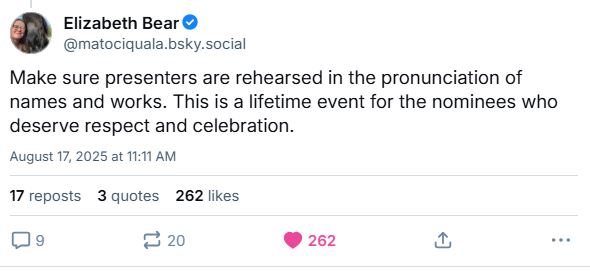
Aside from a Bluesky post by Elizabeth Bear, there has been no discussion, no articles, nothing beyond social media rumours. This is being relegated to the dustbin of history. An unfortunate faux pas. An oopsie.
I shall not let it fade away.
In the global forum that is the internet, I rank just slightly above a street preacher with a megaphone. I don’t expect this essay to be seen by more than a few dozen eyeballs. But my blog will live on for decades, and so will this contemporary record.
It’s 2015, Seattle, tech industry. Many of my coworkers are from India. Their culture fascinates me, as do their names. I take great care to memorize each arrangement of syllables, to commit to memory the names I’d never before encountered. Suyash, Vairavan, Srinivas, and many others. The sole Indian woman on my team is named Vijayalakshmi Deverakonda, and I’m in love with the melodious sound of her name, the way the syllables cascade off my tongue.
The rest of my white coworkers don’t share my respect for people’s names. They routinely call her “Vijay,” which is a male name, and more than a little insulting.
Within two years, Vijayalakshmi and I become workplace rivals. Afterward, we don’t stay in touch. But for a few months, I knew I’d made a fellow immigrant happy because I’d gone the extra mile to learn her true name, to treat her like a fellow human being.
Every failure can be explained by one of these two fundamental explanations: evil or stupidity. Malice or ignorance. It’s often hard to determine which of the two is the main factor. When people make assumptions, and when they build further assumptions on such shaky foundations, their ultimate conclusions diverge from reality.
I make no assumptions. I can believe that a celebrity of the literary world, the main announcer chosen by the 2025 Worldcon committee far in advance, was merely ignorant, and maybe nervous, but not evil.
I say this to myself, and then I remember that giggle in the middle of that unusual name.
Here is how to pronounce “Grigory Lukin.” The first name rhymes with “story.” It has nothing to do with the name “Gregory.” The last name rhymes with “win.” It does not at all sound like “looking.”
For the purposes of brevity, this essay will not cover the pronunciation of my consonant-rich patronym.
It’s 2017, Seattle, the same stressful tech company where white and Indian employees mingle but don’t mix. In a work chatroom, a fellow white guy makes a dirty joke about an Indian woman whose first name is Sukdeep.
I submit an HR report, as do several of my Indian workers. They’re surprised that I would care. To me, that’s a matter of fundamental human decency.
My white male coworker is a successful programmer. He gets a chat with HR, but suffers no further consequences.
The Hugo awards presenter is neither white nor male nor a programmer. But they are successful.
I live in Québec these days. Either here or in America, I can pass for a local, as long as I don’t open my mouth or show my ID. My Russian accent will never truly go away, and for as long as it stays with me, changing my name to something more Western-sounding would be futile. I shall always be The Other.
We rarely speak of this – we who have made a life for ourselves in the West, we who have fully integrated, we who have found a niche in this world. We rarely voice that deep-seated anxiety: do our new compatriots actually accept us? Or are we still viewed as The Other? Do they chuckle and mock our names when we’re not around? Do they bother to view us as fully human even as they enjoy our writing, our films, our art?
We’ll never know for sure. It shall forever be unknowable. Probably paranoia, nothing more.
And then the host of the most prestigious sci-fi and fantasy awards ceremony giggles while reading a foreign name, and the deep-seated anxiety flares up, and I think that maybe it’s not paranoia after all.
The importance of names is an ancient concept, perhaps even eternal. Even today, some cultures give their children a fake name to ward off evil spirits. Religious Jews don’t pronounce the four-letter name of God written in the Torah. Some cults insist on changing their followers’ names to separate them from their past. Many cultures automatically change women’s last names to those of their husbands. Residential schools were infamous for changing Native American children’s names as part of the forced assimilation process. In fairy tales around the world, through the ages, a villain could be defeated only if the hero learned and pronounced their true name.
And at the annual Hugo awards ceremony, the host giggles when they read an unusual name during the highlight of someone’s professional career.
Most issues can fit on a spectrum from one to ten.
Refusing to rehearse foreign names and then mangling them during an awards ceremony is more serious than a playground microaggression.
At the same time, it’s far less serious than a large-scale cultural genocide.
At the same time, it’s still on the spectrum.
Things you should do if you’re overwhelmed and nervous while presenting the most prestigious annual science fiction and fantasy award:
1. Take a few seconds to refer to your pronunciation guide.
1a. If a pronunciation guide is not available, demand one. Have the singers come back on stage to fill the gap until the guide is procured.
2. If the pronunciation guide doesn’t exist, take a few more seconds to summon somebody (perhaps even one of the singers!) to help you.
3. Apologize to the audience, invite every finalist to join you on the stage, and have them pronounce their own names into the microphone.
4. Apologize even more profusely. Admit your nervousness and lack of preparation. Give the microphone to somebody more qualified. Walk off the stage. Don’t return.
Things you should not do:
1. Don’t giggle.
2. Don’t goddamn giggle.
You may mock this essay, as is your right. In these turbulent times, as the planet gets ever hotter, as war crimes get more horrific, as genocides get swept under the rug, this is what people complain about?
And yes, sure, you’d be right. Saving even a single starving child from a sniper is infinitely more important than this issue, now and forevermore. And yet, if your first reaction was to scoff, consider this: is your name conventional? Do people ever giggle when they see it? Are you aware of the concept of microaggressions? Would you say you believe in equality, that racism is wrong, that diversity is important? When you claim to be an ally to those different from yourself, do you accept (both intellectually and emotionally) that they have certain issues which you cannot comprehend but should believe?
If there’s ever an apology letter from anyone involved, it’ll probably blame stress, and anxiety, and growing up in a social environment that didn’t have such linguistic diversity.
Over the past five days, there has been no such letter.
I’m prepared to accept that the main announcer (and their helper) was an anxiety-ridden human being, with human biases, with imperfections. I understand. There are eight billion people in this world. Quite a few of them have sins that are far worse than laughing at foreign names.
I don’t demand perfection. I demand basic competency.
This essay isn’t about the Hugo awards announcers. It’s about the stunning incompetence of the ceremony’s planners.
Here are some things I’d love to learn, but doubt I ever will:
How many times did they rehearse the Hugo song?
How many times did the announcers rehearse the names?
Was there ever a pronunciation guide?
If not, why?
If yes, what happened to it?
Was there ever, at any point of the planning process, a voiced objection, or even a concern, that the popular awards presenter would not be able to pronounce foreign names?
If so, what was the reaction?
I’ve been a lifelong reader of science fiction and fantasy. I can go to great lengths to suspend my disbelief. But if you expect me to believe that a racist, homophobic, rural high school in one of the poorest states can find a professional name announcer, while a giant annual convention held in one of the most prosperous cities cannot… I’m sorry. Even I cannot suspend my disbelief that much.
Was the awards presenter chosen on the basis of friendship and connections and good vibes? Were they chosen because they had decades of experience in speculative fiction? Was there no one else available who had a richer linguistic and sociopolitical background?
Would it be fair to say that even if any concerns had been voiced at all, the overall sentiment was to dismiss them and hope for the best? Let’s just do it and be legends, man. We’ll do it live. Fingers and toes crossed. YOLO, eh. What’s the worst that can happen?
A system that awards top jobs based on seniority and connections rather than competency related to the job at hand ceases to be a system. It becomes a joke.
This essay is not about the US politics.
Throughout history, one of the worst and most unusual punishments was to have your name struck from historical record, as if you never existed at all.
Call it petty. Call it poetic. Call it neither, or both. I deliberately choose not to mention the name of the giggling name-mangler in this essay. Likewise for their co-host. It’s a bit ironic, since neither of them had actually introduced themselves when they started the ceremony. (Nice song, though.)
The announcer’s name will probably live on through all their many written works, but this essay will do them no such honour.
Names have power. Deleting them, even more so.
Someday, I hope to be a Hugo finalist. I’ve got about 35 years left; 40 if I eat my veggies. If I ever do get that honour, when my turn comes, will the announcer mangle my name? Will I be afforded the most basic human respect of an identity?
In this genre of dragons and werewolves and rocketships, this is my wildest, most improbable hope: that someday, we shall have awards ceremonies where people with unusual names will be treated as individuals.
“I’m looking for my cheat-sheet before I say something that is difficult for me to say… Let us see… I don’t know if I have any pronunciation guides. Okay, I’ll just – I’ll be corrected when I’m wrong, okay?” https://www.youtube.com/live/py7MeV31ln4?si=_7rZwfn-l5988LjF&t=6061
“And this – I do not know how to say this, but you know how to say this”
Related to the topic of names: a very beautiful short film about a rural woman and an eccentric foreigner with a hard-to-pronounce name, and their resulting friendship. “Meeting Mr. Oscar” https://www.youtube.com/watch?v=QcbPCcpzQ1I
This post is about three months overdue, but I have it on good authority that time is relative. ¯\_(ツ)_/¯
So much has happened… The move from Toronto to Quebec City was an exercise in organized chaos: I managed to pack all my stuff (including all the small detritus of life that takes up an alarming amount of cubic space) into plastic crates, moved them into the small Uhaul truck I rented, and drove it all the way to QC with an overnight stop at a rest area. (My original estimate of completing the 8-hour move-and-drive by 6pm was wildly optimistic.) Then it was all about unpacking and moving my stuff to that shiny, beautiful second-floor apartment that is my home. Returning the Uhaul. Walking back to the apartment, ogling all the French signs and sights. I hope those first memories will never fade away.
At some point, I’ll probably forget and normalize the memory of my first month here, before I got my furniture (mostly Ikea, and a couple of used furniture stores), but it was pure chaos: sleeping on my mattress on the floor before I finally got one of the last beds available at the local Ikea. (With another Uhaul rental – those things are like cheat codes for everyday life!), then navigating through all the furniture boxes in my living room, then slooowly assembling it all over the course of three days or so. Did you know that there actual online support groups for people who try to assemble Ikea’s Malm dressers? Ask me how I know…
There were casualties: I wasn’t careful with my gaming PC (just yeeted it in the back of the truck instead of securing it on the passenger seat like the precious baby that it is), and something inside got misaligned. The nearest computer repair store fixed it, got it working again, and then held it hostage for four days because the technician didn’t write down how much to charge me. Fun times… Didn’t help that they closed early on Saturday despite telling me earlier that day to stop by at 4. I fought that particular spike of rage by finding a great deal on a used 20-gallon aquarium and acquiring three little guppies to go with it. (And a fancy thermometer. And a big wooden decoration. And a couple of little plants. And an air pump shaped like a volcano. It’s pretty fun, eh.) I’m still figuring out the exact water chemistry, and will probably have to splurge on a tap water filter to make sure they get dechlorinated water when I change it. It’s an ongoing but fun project – and when it comes to the expense/cuteness/stinkiness ratio, fish are far better pets than birds or mammals. (There are also reptiles, of course, but they’re not as cute in my utterly subjective opinion.)
Quebec City itself is beautiful… Just google its pictures and see for yourself: that’s not just one small touristy block, that’s a good chunk of the city, and there’s more beauty in other parts of it, too. All the parks have lots of trails and pathways for pedestrians, bicycles, skateboards, etc. It turns out Duolingo had lied to me, and the Quebec-French is quite different from French-French. The few times I tried saying “enchante” (pleased to meet you) to new acquaintances, the response was mostly “WTF does that mean?” Heh. It’s getting better, though: while I still can’t follow other people’s conversations at parties (just smile and nod!), I can mostly figure out what I’m reading by recognizing the key words.
It turns out the local government pays a $200/week stipend to encourage newcomers (other Canadians, or immigrants like myself, or refugees) to learn Quebec-French and Quebecois culture. It’s an intensive program – five days a week, up to six hours a day, for twelve weeks – but it sounds like an amazing deal. There’s a distinct lack of good apps that teach Quebecois French, and I will have to become fluent anyway… Might as well. Just need to send off some documents on Monday, and then they’ll slot me into the next available class, whenever that might be. Quebec’s government isn’t perfect, but this “bribe to learn” program they’ve set up to preserve and promote their culture and their language is downright brilliant. Kudos, at least on that front.
My PR (permanent resident) card is finally here, after spending seven weeks bouncing between Toronto and Quebec. (My neighbour in Toronto means well, but for some reason he didn’t write his return address on the envelope when he sent it to me.) It’s incredibly shiny and going to make my everyday life a whole lot easier. I celebrated with a meal at my favourite local diner, La Cuisine. Check it out if you ever visit Quebec City: friendly staff, great decor, delicious food, low prices. What more can one ask?
…you know how some movies have that cliché where the main character travels to a strange foreign land and just happens to bump into a local guide that speaks fluent English, has a ton of badass qualities, and is an overall improbably awesome and helpful human being? Turns out that actually happens! My new Quebecois girlfriend is a certified badass that does krav maga, knows how to ride any non-motor thingy that has wheels (roller skates, longboard, etc), loves simple and healthy living, etc. What’s even better is that she’s also open to the idea of becoming a professional nomad, doing her graphic design work on her laptop while vegging out in some cheap tropical country. My life is highly improbable, I know, and for that I am incredibly grateful.
It’s been six months and twelve days since I left Amazon for good. (Unless, of course, they decide to pay me back the 47 shares that they owe me; then I might – might – consider entertaining the preliminary notion of possibly going back.) The time flew by, and I feel so much more relaxed and healthier… This whole “early retirement” thing is great, really. Five stars, would try again, highly recommended. I could stay in the rat race another five or 10 years, become a multimillionaire, get more shiny toys, but I’d never get those years back. You can double your net worth – you can’t double your life expectancy.
To give you some idea of how sweet this life is, the only things on my calendar are:
the final expanse book coming out in 3 days;
liquidating all my stocks in late December because I’m quite convinced there’ll be a major correction by April. (Student loan payments will start up again. People will owe taxes on their huge 2021 gains. None of that is good news. Keep in mind that the dot-com bubble burst in March, when the 1999 taxes were due…)
a cool date at the opera with gf in January;
an equally cool long weekend getaway with gf and her friends at a rented cottage somewhere in rural Quebec in February;
possibly a family reunion in March-April-ish?
In September 2022, I will have lived in Quebec for 12 months, which will make me eligible to join the local Freemason chamber. They’re an odd group, but I like what I’ve learned about them so far. When the world begins to fall apart (sort of like in Vancouver, which is currently inaccessible by road thanks to the flooding and mudslides), it’ll be vital to have a gigantic support network on your side. Prepping and stashing food and guns and medicine is only the first step. The second step is getting to know your neighbours (are they medics? cooks? people with no particular skills but with great vibes?). The third step is acquiring an army: a giant social network you can rely on, no matter where in the world you are. I considered other options, like Scientologists, Mormons, Jehovah Witnesses, etc, and decided against them – and Freemasons actually seems like a fun and non-judgmental bunch, and a great way to learn new stuff, and make new local friends, and liven up ye olde social calendar. Too bad they have a strict anti-nomad policy in Quebec, thus the 12-month waiting period first.
At some point, most likely May 2023, I’ll be eligible to apply for my Canadian citizenship, and once I get that, I’ll finally start my life as a snowbird, thus completing my weird, weird metamorphosis. Until then, though, I’ll spend a couple of winters here in Quebec. It’s pretty ironic that the goal of my early-retirement journey was to live someplace cheap and tropical, yet I’ll have to live through the coldest winters of my life (since leaving Siberia in 2003, anyhow) as the last rite of passage. Heh.
And now, after a walk through the snow and a bit of exercise, I’m off to do some more gaming (gf is in Montreal this weekend) – Sunless Skies is both amazing and cheap – while listening to the excellent Ologies podcast (amazing pop science in 90-minute-long increments!), followed by a homecooked meal with a glass of red wine, and maybe another Werner Herzog movie. (It is my new quest to watch everything he’s ever written and/or directed. Two movies down, dozens to go!)
Over the past 10 years, I’ve often thought about leaving Nevada and seeing what it’s like to live in a more or less normal state. Don’t get me wrong: there’s a lot of entertainment value in getting text message alerts every time bears come down from the mountains and go dumpster-diving in people’s backyards; ditto for weekly meth lab busts and crazy tourists who either drive 20 miles below the speed limit or try to live out their Fast&Furious fantasies fueled by midlife crises. And then, of course, there’s the Las Vegas Metro, who always try to match LAPD in wanton cruelty and overall stupidity.
Granted, all of the above makes for some great entertainment (especially when viewed from afar, preferably from behind a barricade), but after a while the entertainment value of these shenanigans tends to decrease. Sure, there were some good times as well, but overall I’d probably have to call it a tie.
I’m writing this on the eve of my departure for Texas. It’s a bit funny that my escape from Nevada came from such an unlikely source: a temp job in a warehouse that I took during the mean, lean winter of 2009, when my company was the only one hiring in Northern Nevada. Two years down the road, I transferred to our Las Vegas branch. Then I got promoted and honed my skills to the point where I got picked to be the data analyst at the company’s brand new facility in Fort Worth. Looking back, I find it hard to believe that all of this came from my decision to stand in that long line at the temp agency. That was one weird gamble, but sometimes weird gambles pay off – especially in Nevada.
I suppose I should write about how much I’ll miss Nevada and shed a solitary, manly tear for the state I’ve called home all these years. I don’t really feel like it, though. The departure evokes neither good nor bad feelings. I look forward to meeting Texans and living in a completely different state, but that’s about it. I suppose that’s what Kurt Vonnegut meant when he said “it’s impossible for me to get emotional about it, because real estate doesn’t interest me.”
Yesterday was the 10th anniversary of my arrival in the United States of America. It was a pretty tumultuous 3,653 days. I feel a bit bad that it had taken me most of that decade to figure things out and get my head on straight, but oh well… I missed out on quite a few opportunities and adventures, but the things I didn’t miss out on were pretty damn awesome: I was briefly stalked by the Secret Service, I almost got killed by an angry mob at a charity raffle, I lost $10,000 for saying “thank you” and then came this close to winning another $10,000 by throwing a basketball 200′ across a river. (It was a matter of inches!) I’ve survived the Mayan apocalypse of 2012 and both terms of the Bush Jr presidency. I’ve gone from sounding like Borat to being interviewed by New York Times about one of my e-books. I’ve gone from being an immigrant with $42 in his pocket to getting paid $10,000 by a Fortune-50 company just for moving to one of their new facilities. I’ve done things that are illegal in some parts of the South and witnessed the sort of breathtaking beauty that most people would be lucky to glimpse in their dreams. I did pretty well, if I do say so myself.
Now on to year 11, the second decade, the next chapter.

 Grigory Lukin.com